Showing posts with label Commodity. Show all posts

Thursday, March 10, 2011

VIDEO: Coley Testimony - HB3 Constitutional Tender Act

Coverdell Legislative Office Building (CLOB)
18 Capitol Square SW Atlanta, GA 30334

Atlanta, GA

Monday, March 7 · 9:00am - 12:00pm


After presenting testimony, I engaged in a dialog with Representative Bruce Williamson on fractional reserve banking. Bruce Williamson was a gentleman. He opened with a prayer that I would be blessed to hear and concur with any time. The problem we have is that neither Bruce, myself or government are the standard. A good man's character does not make an objectively immoral practice moral or right.


Representative Williamson claimed that Georgia banks don't create money, yet he later said:
I'm not disagreeing with the fact that it expands the money supply, but I don't see that that's inherently unhealthy.
Evidently Representative Williamson doesn't understand that "Expanding the money supply" creates new dollars and is inflation.

When I said that banks create dollars from nothing, Representative Williamson disagreed yet again, stating:

Its not nothing. Its promises to pay that provides the liquidity to shop keepers, to home owners...
And:
All you're doing there is allowing these promises to pay, that when you come to borrow the money to buy the automobile or piece of land or buy new shelving for your hardware store, all the bank's doing is turning around and lending you those dollars... It's not the collateral, its your promise to pay back.
In other words, his view is that the money is not created from nothing, rather it is created because the borrower promises to use his land, labor and capital to produce enough to pay the loan back, plus interest to the banker.  The banker has essentially no skin in the game.

If "its not the collateral", why does the banker take the borrower's collateral if the borrower doesn't pay?

In an honest system, the banker would have to loan out property that actually exists in order to earn interest. In the fractional reserve system, he creates money from thin air and then essentially loans your property to you - and gets paid interest for doing it. The bank brings nothing to the table except the legal privilege to create money.

When you borrow money for a piece of land, the money that you use to pay the seller comes from a ledger entry at the bank which is made because you agree to pay the money back. The only real asset in the transaction is the land. The banker has no equity or asset in the transaction at all. If you default, he gets the land.

Of course that ledger sheet trick works until the bubble pops, particularly when the bubble is combined with Sarbanes-Oxley and federal regulators.

Representative Williamson also stated plainly that leaving the gold standard was a mistake.
It all goes back to fiat inflation. I do not disagree one bit with the fact we should never have gotten off the gold standard. I think Steve Forbes has got it right, but all we are is dealing with the Federal Reserve Notes that our Federal Treasury is [unintelligible] the currency of the nation.
However, the Gold standard simply limited the amount of new money created from nothing by the Federal government. Creating money from nothing is always a problem because the mechanism makes an economy unsustainable. The economy is unsustainable because costless money causes a breakdown in the price mechanism and distorts the allocation of resources.  It also pillages and weakens the producers.  The banks create new money from nothing, much the same as the Federal Reserve. In fact, the banks are able to create nine new dollars for each one new dollar created by the Federal Reserve. Which is bigger? Nine or One?

If costless money is a problem and the banks create more than the Federal Reserve, then the banks are not innocent. They participate in inflating the money supply, or to use Representative Williamson's phrase in "expanding the money supply", which IS inflation. It disproportionately harms the weak and frugal. It enriches those who are granted a special privilege by government (banks) to create new money from nothing - at least from nothing that the banker owns. In the banks view, your property gives them the right to create money that didn't exist in order to charge you interest for using the money.  What a racket.  

There is so much more that can be said and the problems are far reaching and complex, but the bottom line is that fractional and fiat money cause theft and lead to poverty and oppression.

Tuesday, March 8, 2011

Bill Greene - HB3 Constitutional Tender Act

Coverdell Legislative Office Building (CLOB)
18 Capitol Square SW Atlanta, GA 30334
Atlanta, GA

Monday, March 7 · 9:00am - 12:00pm


Excellent job making the case by Dr. Bill Greene and Representative Bobby Franklin.


Monday, March 7, 2011

My Testimony - HB3 Constitutional Tender Act

Click here for the video and response from the committee.


Coverdell Legislative Office Building (CLOB)
18 Capitol Square SW Atlanta, GA 30334
Atlanta, GA

Monday, March 7 · 9:00am - 12:00pm

Good morning. My name is Shane Coley.

I have studied history and economics extensively.  I was raised in the cattle business, I can operate or rebuild heavy equipment and I am a professional software architect. I am self-employed. I was recently a candidate for state Senate in the 47th District where I carried my home county.  My positions here today match my positions during the campaign.

The laws of Georgia are created and modified by our state legislature.  The legislature is made up of individuals, like you, who analyze legislation in the context of your personal belief system, which makes your belief system very important to Georgians.

The majority of the banking and finance committee members publicly claim to be Christian. Therefore, I will talk about some of the general constraints or limits of the Christian belief system, and then about secular belief regarding theft or stealing.

In at least nine places the Bible tells us about differing weights and differing measures.  In at least four places the Bible says that differing weights and differing measures are an abomination to God.  A Christian must not ignore this.

Here is an example of differing measure:  Suppose I were in the market buying wheat and I had a basket marked one bushel, but the basket was secretly larger than one bushel.  My oversized basket would enable me to steal part of your wheat. 

Differing weights and differing measures deceptively cause theft, which is a violation of the Eighth Commandment, "You shall not steal".

Since 1971, the only way to create a new US dollar is to record an entry in a ledger of the Federal Reserve System, or in a ledger of your local bank.  Producers have to work years for new Dollars that the bank creates instantly with the stroke of a key.

When new US dollars are created in this way, there is no new wealth created, but the purchasing power of all previously existing dollars is decreased.  This is an example of using differing measures to steal labor and property from producers.

This is clearly, undeniably, objectively a form of theft. To support fiat or fractional money is to support theft. 

Some claim that our money system makes us wealthy. This is false. Wealth is the result of production.

Many of us notice that People depend on Production. People eat food and use things. Food and things must be produced. Government Produces nothing and wastes much. Since people depend on production and government interferes with production, there is no way that government has any solutions for us. We must remember that every promise made by a government official has to be kept by a producer. There is no other way.

It is impossible to confiscate a loss. Only profits or capital from past production can be confiscated. It is logically impossible for the creation of new US Dollars to make us wealthy. If I had time, I would prove that creating costless money will first make us poorer and eventually crush our free society.

The reality is that the creation of costless money can only lead to the destruction of a free society.

For those who are not constrained by the Christian belief system, if you oppose theft then you must oppose creating new US dollars from nothing.

Please listen carefully to the following quote from an old banker.

“The few who understand the system, will either be so interested in its profits, or so dependent on its favors that there will be no opposition from that class. The great body of people, mentally incapable of comprehending the tremendous advantages will bear its burden without complaint.”

To the Christians and those who oppose stealing: I respectfully ask that you vote for the Constitutional Tender Act as a small step toward eliminating differing weights and differing measures and theft from our monetary system.

And finally, let’s recall a bit of what John Maynard Keynes wrote in 1919: “while [creating costless money] impoverishes many, it actually enriches some” and also “[Inflation] engages all the hidden forces of economic law on the side of destruction, and does it in a manner which not one man in a million is able to diagnose.”

To those members who hold stock in banks or have otherwise profited from the banking business: Since our loss is your gain, I respectfully ask that you recuse yourself from this vote and from the vote on the final bill.

Sunday, January 17, 2010

Soil and Liberty


Our nation is at a crossroad. We are facing the potential collapse of our currency and the following disintegration of our society. There are technical reasons this is true. Some mainstream financial advisors take this position. Certain economists take this position.

Our security depends on knowledge. Please consider the following ideas.

Dollars

Imagine a Wall Street hedge fund manager who has acquired millions of dollars in the previous year. Imagine if he sold everything of value he had, including house, clothes, cars, etc. and only held dollars. Imagine that he never traded those dollars for anything. He just held his dollars.

Is he wealthy?

Or is he hungry and cold?

He cannot eat, wear or be sheltered by his dollars. Unwilling to part with his dollars and having no other property, he is a man in poverty.

This would also be true if he held a currency that no producers would accept in exchange for goods and services. This is the current situation for Zimbabwe Dollars.

Soil

Let’s say our Wall Street banker finds this situation to be untenable.

He is hungry and cold.

So he buys food, shelter and clothing. These are all directly or indirectly based on products which come from the soil.

The people who produced these things live in houses, wear clothes and eat food which are dependent on soil.

So, even the Wall Street banker has nothing if he only has dollars. And even the Wall Street banker is directly dependent on soil.

All nations are agrarian or have agrarian dependencies, whether they know it or not.

Only a fool believes a nation can survive without a strong agricultural base.

Only an enemy would undermine a nation's agricultural base.

Our agriculture and industry have been undermined.

Production

Have you ever noticed that everything we do or use relies on production?

Consider the following questions:

Can we agree that if a person stops eating, he will die?

Can we agree that if a person is dead, he no longer thinks, at least temporally speaking?

Can we then agree that thought relies on food?

Can we agree food must be produced?

Can we then conclude that thought relies on production?

If thought relies on production, can you name even one thing that you do or use that does not rely on production?

Teachers

Teaching can be edifying or destructive. One can be taught to build or to tear down.

If teachers have a desire to promote and support the teaching profession or society as a whole, they must teach production.

If a teacher simply wants to be guaranteed a certain quantity of paper tickets, like dollars, perhaps they should move to Zimbabwe. People in Zimbabwe have plenty of paper tickets. Of course the people starve, but even the poorest person has vast quantities of worthless paper money.

Perhaps teachers actually want valuable incomes so that they can enjoy food, shelter, clothes, relationships and leisure activities.

If food, shelter and clothing are what the teachers want, they should NOT lobby the government for guaranteed quantities of dollars. Instead, since everything we do or use relies on production, they should teach the students how to be productive.

Anything that interferes with the freedom to teach students how to be net productive should be considered an enemy of the teacher, student and society.

Fundamentals

I have noticed that people eat food and use things.

The government produces nothing and wastes much.

Government has nothing to give.

Everything we do or use relies on production.

Through taxation, regulation, litigation and inflation, government reduces the quantity of production, which makes us all poorer.

The things we use must be produced.

I have noticed producers exchange with producers. Paper money which has been devalued and made worthless will not be accepted by a producer. Our dollars will soon be worthless, which means producers will not accept our dollars in exchange for what they have produced.

We have destroyed agriculture and industry in our nation.

We are losing generational knowledge and trade skills.

We can no longer produce adequate quantities of what we need and want.

Conclusion

Paper money is poverty. Electronic money is death. All nations which debase their currency have collapsed.

Unless we learn the truth about production and the truth about money, we will lose our liberty and prosperity. Unmistakable poverty and tyranny will take its place.

Dollars are worthless and useless in their own right. We must understand the true foundations of liberty, beginning with soil and production. Otherwise, when dollars can no longer be exchanged for production, we will witness the disintegration of the United States as we know it.

Every man, woman and child must learn and teach the truth about production and the truth about money.

If we do that, the United States of America will again be strong, prosperous and free.


Tuesday, July 14, 2009

Economic Terms in Scripture

Normally I would read the following list and ask the hearer to consider possible labels for the category.

So far, I have found agreement that economics is a suitable heading for the list.

Next I ask where the list was sourced. The answers are always reasonable and sometimes correct, since it really is just a guess. Some say economics books, dictionary or Scripture.

The answer is Scripture.

The third question follows the list.

Profit
Gain
Exchange
Bought
Price
Forfeit
Repay
Costly
Redeem
Ransom
Redemption
Cost
Inherit
Calculate
Enough
Wealth
Sell
Buy
Value
Debt
Certificate
Cancelled
Talents
Possessions
Debtor
Gift
Free
Forgive
Credited
Account
Due
Wages
Treasure
Deposit


What are the subtopics within Scripture from which these terms were drawn? Please read the list and answer for yourself before advancing.


The subtopics are salvation and the relationship between God and man.

Matthew 16:26-27 “For what will it profit a man if he gains the whole world and forfeits his soul? Or what will a man give in exchange for his soul? “For the Son of Man is going to come in the glory of His Father with His angels, and will then repay every man according to his deeds. NASB95

1 Corinthians 6:20 For you have been bought with a price: therefore glorify God in your body. NASB95

1 Corinthians 7:23 You were bought with a price; do not become slaves of men. NASB95

Psalm 49:5-9 Why should I fear in days of adversity, When the iniquity of my foes surrounds me, Even those who trust in their wealth And boast in the abundance of their riches? No man can by any means redeem his brother Or give to God a ransom for him— For the redemption of his soul is costly, And he should cease trying forever— That he should live on eternally, That he should not undergo decay. NASB95

Revelation 21:6-7 Then He said to me, “It is done. I am the Alpha and the Omega, the beginning and the end. I will give to the one who thirsts from the spring of the water of life without cost. “He who overcomes will inherit these things, and I will be his God and he will be My son. NASB95

Colossians 2:2 that their hearts may be encouraged, having been knit together in love, and attaining to all the wealth that comes from the full assurance of understanding, resulting in a true knowledge of God’s mystery, that is, Christ Himself, NASB95

Luke 14:27-29 “Whoever does not carry his own cross and come after Me cannot be My disciple. “For which one of you, when he wants to build a tower, does not first sit down and calculate the cost to see if he has enough to complete it? “Otherwise, when he has laid a foundation and is not able to finish, all who observe it begin to ridicule him, NASB95

Matthew 13:44-46 “The kingdom of heaven is like a treasure hidden in the field, which a man found and hid again; and from joy over it he goes and sells all that he has and buys that field. “Again, the kingdom of heaven is like a merchant seeking fine pearls, and upon finding one pearl of great value, he went and sold all that he had and bought it. NASB95

Colossians 2:14 having canceled out the certificate of debt consisting of decrees against us, which was hostile to us; and He has taken it out of the way, having nailed it to the cross. NASB95

Matthew 6:12 ‘And forgive us our debts, as we also have forgiven our debtors. NASB95

Matthew 25:14-15 “For it is just like a man about to go on a journey, who called his own slaves and entrusted his possessions to them. “To one he gave five talents, to another, two, and to another, one, each according to his own ability; and he went on his journey. NASB95

Romans 6:23 For the wages of sin is death, but the free gift of God is eternal life in Christ Jesus our Lord. NASB95

Romans 4:3-9 For what does the Scripture say? “Abraham believed God, and it was credited to him as righteousness.” Now to the one who works, his wage is not credited as a favor, but as what is due. But to the one who does not work, but believes in Him who justifies the ungodly, his faith is credited as righteousness, just as David also speaks of the blessing on the man to whom God credits righteousness apart from works: Blessed are those whose lawless deeds have been forgiven, And whose sins have been covered. Blessed is the man whose sin the Lord will not take into account.” Is this blessing then on the circumcised, or on the uncircumcised also? For we say, “Faith was credited to Abraham as righteousness.” NASB95

2 Timothy 1:14 Guard, through the Holy Spirit who dwells in us, the treasure which has been entrusted to you. NASB95

2 Timothy 1:14 By the Holy Spirit who dwells within us, guard the good deposit entrusted to you. ESV


Much can be said about this economic correlation to spiritual and eternal things in Scripture. The implications are far reaching. It seems to me that in order to understand God's view of economics in spiritual matters, we must have a correct temporal view of economics.

I will save other commentary and illustrations for another time.

Monday, July 6, 2009

Benefits of Natural Money


Following is a simple but powerful chart that explains a key difference between the Austrian School of economics and the Keynesian School of economics. (I cringe when using the label "Keynesian School of economics", since it is actually a political ideology with no basis in economics, except in terms of destruction.)

What we are looking at is the way that each system views Private Property and Time.

Note: To be more brief and direct, I will ascribe positions to the Austrian School based on my own interpretation. To get a full spectrum of Austrian views, refer to the vast library of materials on the subject.


First let's briefly look at Private Property.

Austrian View

The Austrian School holds that Private Property is inseparable from Liberty.

Therefore, a just economic system will not include any scheme that forces a person to work in order to retain his private property.

Keynesian View

In the Keynesian system, property tax essentially makes a person a tenant on government property. If the present owner does not produce enough to pay the tax, the government takes the property away and assigns it to a serf, I mean citizen, who will produce enough to pay the tax.

The Keynesian system is designed to allocate property based on production. The state is to be the beneficiary of the productivity of the property manager.

(We sometimes think of the Keynesian property manager as an "owner", but a true Keynesian never does. A Keynesian knows a serf when he sees one.)

Next let's briefly look at Time.

Austrian View

The Austrian School recognizes that people are more prosperous based on quantity, quality and efficiency of production. The more people produce, the more prosperous the society becomes.

It really is a simple idea. Produce more, have more.

In simple terms, to be more productive, we use machines.

Machines enter the production system through innovation, engineering, testing, manufacturing and deployment.

In order to bring a more efficient machine into the production process, one will need to use capital. The capital will come from real savings of real property which has been produced and collected in the past.

In simple terms, if my new machine makes everyone ten percent more efficient, then our purchasing power will increase by ten percent. We will all benefit from the extra production.

If the producer's project fails, then the producer will lose his collateral.

The investor will gain or lose based on the value of the collateral.

However, since everything we spent was a result of actual production in the past, every vendor was fully paid and society is essentially unaffected. (There are effects, but the effects are positive and not important for this discussion.)

Keynesian View

On the other hand, the Keynesian approach is based on consumption. The idea is that if we increase spending, the economy will prosper. A sophisticated argument can be made, but I will keep the explanation very simple by noting two things.

First, the Keynesians explicitly state that the purpose of their system (which we have used for over 100 years) is to destroy capitalism and therefore to destroy liberty.

In other words, the consumption model is bad, to put it lightly.

Secondly, because the way the "economy is stimulated" is by borrowing against future productivity in the form of costless money, this approach is like an individual attempting to borrow his way out of debt. That doesn't work.

The Keynesian model is anti-liberty, anti-capitalism, anti-prosperity and leads to destruction. Keynesianism is about instant gratification and promises the bill will be paid with future (read "kids and grandkids") production.

The Austrian model is in agreement with Biblical principle and leads to liberty, justice, prosperity, and personal accountability. The Austrian School is about good stewardship of work that has been completed in the past.


Saturday, April 4, 2009

Regression to Productivity


Based on math, reason and logic the argument I am presenting here can be sustained.

The intent in this article is not to prove the claims, but simply to state them in simple terms.

If you disagree, please begin by explaining your case for how our current system is working well and is not to blame for the current bust.


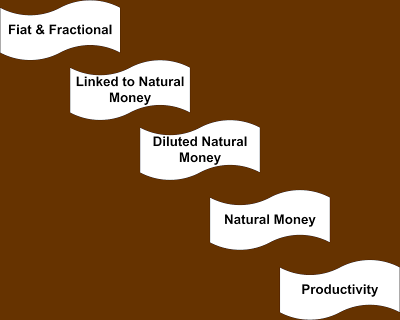
Very simply put, money must always originate through voluntary exchange of a commodity which initially has other uses.

A simple paradigm breaking example is butter. It begins as something that people produce to serve a particular purpose and then, because of certain attributes like fungibility, divisibility and reasonable durability, it rose in some markets as a commodity used in indirect exchange, i.e. money.

Which came first, a) the usefulness for other purposes, b) usefulness as a commodity for indirect exchange or c) were these uses concurrent? In the case of butter, the rise to money would be sequential, while in the case of gold or silver, I consider the rise concurrent.

In either case, the commodity is the original money because government cannot introduce an unlinked currency to market. The link always regresses to a commodity which was respected and accepted in exchange because of various attributes, number one among them being the productivity filter. There was no need for a government agency to ensure the "value" of a commodity that everyone clearly understood required productive labor to acquire.

Compare these two questions:

Hey buddy, did you just get that gold out thin air, or did you work for it?

Hey buddy, did you just print that dollar, or did you work for it?

The gold had to be mined. The paper costs nearly nothing to produce. In a matter of milliseconds enough "dollars" can be produced to buy entire countries. Try that with gold or any other natural money. Society can't get around the productivity filter with natural money.

Today we suffer under the abuses of an unlinked fiat currency. This means the government does no work in order to produce their claims to our labor. Fiat money is also called costless money.

Prior to that we had a linked currency, i.e. notes that were linked to a reserve of gold and silver. With our linked currency there was at least the claim that some quantity of gold or silver was stored somewhere that someone worked to produce.

Prior to that we had the age of coins. These were diluted with base metals as a crude and unsophisticated form of inflation. The king would collect 100 gold coins in taxes, melt them down, mix in some cheap base metal and then produce 150 new coins to spend. Basically if the coins were purified and separated, the king would have the 100 original coins which would spend fine, but then also 50 coins made of tin. The effect is the same as if he came to purchase goods from you using his 50 tin coins (covered with gold paint of course) and expected you to treat the tin as though it were gold. Spending the tin as though it were gold is no different when a little is mixed in with every coin than it is if it all resides in a few. It is theft either way.

Prior to that were commodities. Natural money, honest money, sound money. People used gold and silver, sometimes copper or other commodities, as a medium for efficient indirect exchange.

And prior to that came productivity. One person raised sheep, another wheat and yet another mined gold and silver. There would be no gold to trade unless someone dug it up and refined it. That is hard work.

I am aware of no case in which a government has ever successfully introduced a money token that was not dependent on a commodity, which was originally introduced in voluntary exchange and secured by the productivity filter.

Therefore, when the government decrees quantities of costless money, they are actually decreeing their claim to your productive labor and through this decree of quantity, the government demands and ensures confiscation of your property by force.

We must understand that no productive labor is exempt and no one can opt out of working specifically for the destruction of what they hold dear, unless they are among the few whose goals are in alignment with the actual and intentional product of our present monetary system. To support this costless money system, which bypasses the productivity filter, is to promote systemic theft and scheduled destruction of nations.

Tuesday, March 24, 2009

Money By Decree


This is a discussion about money which references Scripture and is addressed to Christians. Because the argument can be made from other starting points, the principles will stand for any thinking person, but the Scriptural basis will only be valid for those who hold Scripture to be the written word of God, as do I.

The Bible tells us that we must not use differing weights and measures because these are an abomination to God. With a little study we find that the use of differing weights and measures is a violation of the eighth commandment.
Exodus 20:15 “You shall not steal. NASB95
Let's begin by describing how one would use "differing weights and measures."

Imagine that I am a merchant who purchases grain from farmers. I own the baskets and the scales.

If my basket is marked as a bushel, but is actually a bit larger than a bushel, then you have to give me too much grain before I agree that you have supplied a bushel of grain.

If I were buying by weight, then I would have a metal disk that is marked one pound, but actually weighs more than one pound. With this setup, you have to put too much grain on the scale before I agree you have supplied a pound of grain.

In each case I will pay you as though you gave me one bushel or one pound..

In each case you will have given me more than one bushel or more than one pound.

You will have been cheated. After all, if the advantage were yours, it would be a gift, which I would want you to know about.

Following is Scripture which addresses this particular form of fraud and theft.
Leviticus 19:35 ‘You shall do no wrong in judgment, in measurement of weight, or capacity. NASB95
Deuteronomy 25:13-16 “You shall not have in your bag differing weights, a large and a small. “You shall not have in your house differing measures, a large and a small. “You shall have a full and just weight; you shall have a full and just measure, that your days may be prolonged in the land which the Lord your God gives you. “For everyone who does these things, everyone who acts unjustly is an abomination to the Lord your God. NASB95
Proverbs 11:1 A false balance is an abomination to the Lord, But a just weight is His delight. NASB95
Proverbs 20:10 Differing weights and differing measures, Both of them are abominable to the Lord. NASB95
Proverbs 20:23 Differing weights are an abomination to the Lord, And a false scale is not good. NASB95
Micah 6:11 “Can I justify wicked scales And a bag of deceptive weights? NASB95

Money and Differing Weights and Measures

There is a concept known as legal tender law which controls how we use money. Basically legal tender laws state that a certain money unit must be used and accepted at face value. (This is not good or right...)

So here is how this bit of positive law plays out:

Imagine that you have a gold coin which is marked "10" and was originally "coined" with ten units of gold having a given purity.

There are four basic things that can happen to this coin to change its gold content relative to the stamped or engraved quantity.
  1. It may be worn over time which is a natural process and which is harmless if the coin (more properly the unit of gold) is traded by weight.
    (See Money and Scripture)
  2. It may be clipped, which is to say a bit of the coin is scraped or shaved off and collected by the person doing the clipping.
  3. It may be diluted by melting the coin, mixing in a cheaper base metal and then recasting a new coin with less gold, but the same markings.
  4. It may be a consistent weight of gold, but be melted down and then given a larger nominal value stamped on the outside.

Now imagine that I owe you 1000 units of gold. I deliver to you 100 coins marked "10", but all of these coins have only 90% of the gold indicated by the markings.

By law you have to accept these coins as though I paid 1000 (100 X 10 = 1000) units of gold, when in fact I have only paid 900 (100 X 9 = 900) units of gold.

Fundamentally, what has happened is this:

The government has issued a decree that states the coins which contain nine units of gold actually have ten units of gold. In essence they have claimed to have created ex nihilo (from nothing) a unit of gold.

The government has decreed, with the stroke of a pen, the existence of an extra unit of gold.

Decree: an order, usually having the force of law

Anyone else would have to own property and operate a mine in order to bring new gold to market. The government simply decrees its existence.

The decree of gold by government is a critical point because in all cases fiat and fractional currencies depend, for their very existence, on an original commodity which was voluntarily accepted by the market for use in indirect exchange. The US Dollar began as 371.25 grains of fine silver and eventually was tied to gold. This tie was damaged in 1933 and broken in 1971. But the dollar could never have been introduced to market except by being relative in value to a natural money (like gold or silver) or something which ties historically back to a natural money.

The decree of gold by government is also a critical point because what is actually decreed is a quantity of natural money. This logic holds true all the way through today, in 2009, with fiat and fractional currency.

The government never decrees value of money tokens or even sound money (well, when they try the market smashes them in the ground and laughs). They can only decree quantity.

Decree of quantity affects value because of the law of supply and demand.

The greater a quantity of a commodity, the less valuable each unit is. Therefore by creating more units of money by decree, the value of each unit declines.

For a simple example, imagine the hottest toy with which you have ever had any experience. Maybe a few marbles or an X-Box. Without thinking about money or purchasing, imagine a room of 20 kids; in that setting three or four marbles or a couple of X-Boxes would be in high demand.

However, imagine if there were hundreds of thousands of marbles of all sizes or tens of thousands of X-Boxes. The same kids who would fight over one or two, in a room with thousands would go home happy while leaving nearly all of the excess units in the room.

As supply increases, the marginal value of each additional unit decreases.

Decree of Quantity

Therefore we can make some observations and draw some conclusions.
  1. Through inflation and bailouts, the government is decreeing a quantity of money tokens which tie back to gold, silver or some other commodity; i.e. natural money.
  2. By decreeing a quantity of money tokens, government is actually decreeing a quantity of natural money; i.e. decreeing gold or silver out of thin air.
  3. Commodity money provides a productivity filter, i.e. requires productive labor to be expended in order to introduce the commodity to market.
  4. Therefore the government is actually decreeing a quantity of productive labor. (See Purchasing Power and Productivity)
  5. Therefore the government is decreeing a particular kind of productive labor, i.e. profitable labor which produces more than it consumes.
  6. Therefore the government is, by decree, laying claim to the labor and creativity of the most productive members of society.

Summary

Natural money which actually exists provides, by its nature, a productivity filter. Government fraudulently claims to create, by decree, a quantity of natural money; however, only costless new money tokens are produced. Bypassing the productivity filter, this fraudulent costless money filters out loss and transfers only profits from producers to the favored groups who receive and use the additional quantity of costless money first.

(See The Purpose of Inflation)

Saturday, March 14, 2009

Purchasing Power and Productivity


Can you imagine an exchange that does not have productivity mixed in?

I believe that it is impossible to have an exchange without productivity mixed in.

Net productivity may be consumed in the exchange or may be generated, but there is always productivity mixed in with any exchange.

Money is not a necessary ingredient in exchange.

Exchange can occur without money.

I will illustrate these points with a simple example.

Suppose you owned 100 train cars filled with gold. Let’s assume that the cars are secure and that people are willing to accept gold in exchange.

Could you purchase a hamburger with some of your abundant supply of gold?

The answer is a dependent yes. There is a prerequisite of productivity.

Someone must till the ground, plant wheat and make flour. Someone must raise and slaughter a steer to have the meat. Someone must plant a tomato and make ketchup. Someone must collect these and other related ingredients and resources into a single location and prepare the hamburger. And all of this has to happen in an environment that includes the producers being better off to exchange their product rather than keep it.

In addition, your gold would not have been secured, mined, refined, and aggregated unless someone engaged in productive labor.

Additionally, it is possible to exchange the makings of a hamburger for a quantity of fresh chicken eggs, instead of money.

Thus we see that productivity is a required component in exchange while money is optional. This is a critical point.

Think of costless money as a lazy and uninvited slob who barges in to your private dinner and forcibly takes the head seat at the table, demanding your honor and obedience.

Remember, the dinner cannot even occur unless gentle, honest productivity is at the table; perhaps this is productivity generated by the dinner party or perhaps captured by force. But always productivity will be present.

To be clear, money is not required at all. In addition to money not being required, unless it is honest money, money goes even further and steals from your productivity while giving nothing back.

Money gets up from the table, well fed by your labor, with your silverware in his pocket and various other articles openly picked up on the way out the door, all to be delivered back to his masters; masters who control his very existence by the stroke of a pen.

What does this mean?

If productivity is involved in every exchange and money is never necessary in any exchange then we can draw a few simple conclusions.
  1. Apart from Productivity, costless money will never feed even one person one meal.
  2. Productivity alone, without money, is capable of providing food, shelter and wealth.
  3. If a person were hungry or cold and had the choice of solving their problem by choosing one and only one of these two elements, then choosing a quantity of money without productivity would leave them in a worse condition, while choosing from a pool of productivity would enable them to be warm and well fed.
  4. In the case of a gift, the same holds true. If we give costless money apart from productivity, the recipient has nothing. If we give productivity apart from costless money, the recipient has a gift with usefulness and value.

Costless Paper Money

We see that gold apart from other productivity cannot provide anyone with a meal.

What about costless money?

Suppose in our nation there are 1,000,000 acres of farm land and 10,000 factories which produce our food and the products we value in exchange.

Now imagine that we print one trillion dollars.

Do we now suddenly have more acres of farm land? Do we now suddenly have more factories?

Someone may say, no, but with this new money, now we can build more factories!

Why can we? Will you build the factory with paper? Will you plant paper seeds in a paper field? No…? Then what do you mean?

I can only purchase more if I produce more things for which people are willing to exchange their own production. As we produce more and more efficiently, there will be a need for more acres and factories to engage in production. Increasing production requires real resources; bricks and steel, acres and seed - not paper.

All that costless money does is grant the first users of the New Money the fraudulent ability to lay claim to your productivity and property which they have not worked to acquire.

I could print money today and immediately acquire your entire year of production from your factory or farm, without doing anything productive myself. I would simply take your labor and property with the stroke of a pen.

The Keynesian monetary system we labor under does this every single day.

Government Stimulus

Since only productivity applied together with real resources can feed a person or increase one’s wealth, the only thing anyone can ever give in exchange for any other thing is productivity.

When the government issues new costless money into the system and the banking sector multiplies it yet again, the costless money only has value to the extent that productivity is absorbed into the costless money.

If we had trillions and trillions of dollars, but no one planted crops or made things, we would be a poor nation. Consider Zimbabwe. A few decades ago 1 Zim Dollar would buy as much as 1.47 US Dollars. Today it takes 37,456,777 Zim Dollars to equal 1 US Dollar.

Do big numbers on slips of paper make a nation wealthy? No. Impossible.

Therefore when the government prints costless money, your property and productivity are necessarily used to impute value to the new dollars, but someone else gets these "valuable" new tokens. They are worthless on their own account, apart from your labor.

Conclusion

The clear and logical economic arguments against the current stimulus and our monetary system in general are somewhat involved and will not be covered in this article. However, the point that we want to convey is this:

The only thing government can give away is productivity and since government produces nothing, they can only give away your hard earned and valuable productivity. Costless money is nothing except a tool to steal what belongs to you.

Furthermore, if we produce nothing then there is nothing to take and nothing to give away, regardless of how many money tokens are created. Again, observe Zimbabwe for an example.

The more we produce, the more the government has access to, which will be used to do the things government does best; destroy liberty and enslave people.

Friday, February 13, 2009

Money and Scripture


There was a time not so long ago when I would read a verse that talks about money and quite easily correlate that term with the cash in my pocket or the balance in my accounts. After all, that is what we have been taught for a few hundred years.

But what if the word translated money in Scripture were actually something else?

Would this be important for us to understand?

What if our definition and understanding of money is completely different from the actual and intended meaning in Scripture? If there is a difference in meaning, should this difference be clarified?

We all know words take on new and different meaning over time and across cultural and generational boundaries...

Let's look at two passages of Scripture, one in the Old Testament and one in the New Testament:

Regarding Genesis 43:21 I want to illustrate three points.

1) Between the two translations noted below you will notice that one renders the term money and the other the term silver. This helps to illustrate that it is no great leap to challenge the proper English rendering of this underlying Hebrew word.

2) The underlying word is KSP or KeSeP, which is the word for silver. (not money)

3) This verse also has the added feature of specifically referring to the weight of the money, which is actually the weight of the silver. It is the actual quantity of a commodity that is being referenced and traded.

Genesis 43:21 and it came about when we came to the lodging place, that we opened our sacks, and behold, each man’s money was in the mouth of his sack, our money in full. So we have brought it back in our hand. NASB95
Genesis 43:21 But at the place where we stopped for the night we opened our sacks and each of us found his silver—the exact weight—in the mouth of his sack. So we have brought it back with us. NIV

Next let's look at a New Testament example.

1 Timothy 6:10 For the love of money is a root of all sorts of evil, and some by longing for it have wandered away from the faith and pierced themselves with many griefs. NASB95


We see here that the underlying Greek word is rendered love of silver.

What if English translations of Scripture used the word silver every place that the original languages used a word for silver? You know what I mean... Precise and accurate translation from the original language into equivalent terms currently in use today.

If one read silver instead of money each time the original text said silver, one would have cause to wonder about the difference between silver and the stuff we call money today.

The money spoken of and used in the Bible was honest money that, for its part, preserved everyone's property rights. Our money today quite literally causes fraud and theft every single day.

Even if we forget that Scripture says silver, not money, should we really be using the same term for both for honest money from Scripture and the destructive, dishonest, costless money in use today?


Saturday, November 8, 2008

So talk about the other kind of money…


Let's start this way. Which nations have Sound Money?

The short answer is none. To my knowledge there are no nations on the planet which use Sound Money today.

If no one uses Sound Money, what sort of money is in use?

There are 4 basic types of money.
  • Commodity (or natural) money
    • Gold, Silver, Butter [This is Good!]
  • Receipt money
    • Receipt for Gold, Silver, Butter [This is Good!]
  • Fractional money
    • “Checkbook” money. A Bank with $100 in Assets can loan $1000 in “checkbook” money. [This is Bad!!]
  • Fiat money
    • Value is enforced through legal tender laws. No backing. If you need more, just run the printing press. [This is Bad!!]


In simple terms, most nations use FRACTIONAL money in an upside down pyramid on top of FIAT money. This means that FIAT money is considered an “ASSET” in the reserves of a bank.

A bank is required through regulation to hold “ASSET” reserves of 10% (or sometimes less). Therefore if a bank has one million dollars in “RESERVES” the bank can loan to its customers ten million dollars in “FRACTIONAL” money, also called CHECKBOOK money.

Most people are unaware of this fraudulent scheme. At this point one may ask: “So why should I care?”

The short answer is because you are being literally robbed of your property through this system.

(There is one other possibility; the net effect at the end of a period of time is that you are either robbing others or you are being robbed. It makes no difference how much integrity you have or don’t have. We will explain this in another post.)

Supply and Demand

Most of us have heard of the law of supply and demand. Generally we understand this law to explain that as supply increases, price decreases. There are also other attributes to this supply and demand relationship. For example, there are distinctions between charting supply and demand curves, as compared to individual behavior in the market, given variations between supply, demand and price. For our purpose we will stick to a simple definition; i.e. as supply increases, price decreases.

Water

If a man sitting beside a wilderness river in the year 1800 attempted to sell water to travelers, he would be wasting his time. However, if the same man had water that was his private property and his storefront was in the middle of a parched desert, he would have a good prospect of selling water to these same people.

Notice that supply and demand are determined not simply based on “world supply”, but based on available supply, at a specific time and in a specific place, under specific conditions. Water cannot be sold at all by the river. Water can be sold for a potentially unlimited price to a thirsty man in a desert.

Purchasing Power / Supply and Demand

At this point let us note that money is also affected by the law of supply and demand. This is true and can be expressed in different ways. A common way of describing the value of money is PURCHASING POWER. For our example, suppose we know that a car in 1965 cost about $3,000 and today costs about $30,000.

In 1965 $3,000 had enough purchasing power to be exchanged for a new car. In 2008 $3,000 has enough purchasing power to exchange for one tenth of a new car. (Price change is not the whole story of what we have lost, but it will do for our purpose here.)

If the money supply had been stable since 1965 (1965 is an arbitrary date) we would be able to purchase a new car for less than $3,000. There are two basic reasons: 1. The overall increase in products and services would cause prices to go down. 2. The increase in productivity would cause prices to go down.

In other words, in a Sound Money system, if you saved $3,000 from 1965 until 2008 you could purchase a new car and have money left over.

Back to Supply and Demand and Money

What can we conclude from the above comments… based on our simple observations?

We said, in simple terms, that “as supply increases, price decreases.” Then we saw that water can be exchanged for either nothing or perhaps a man’s entire fortune, depending on supply and demand at a particular place and time.

We also saw that our money has lost purchasing power over the years because the money supply has increased.

(Note: This increase in the money supply is called inflation. Our dollar today is worth between two and four pennies compared to a 1933 dollar. Inflation of the money supply is the reason that the Continental notes issued by the Continental Congress became worthless. They flowed in the streets like water in a river and became useless as a store of value for use in exchange.)

So if the supply of money increases (i.e. someone inflates the money supply) then the value of all other money already in existence decreases. This is a simple case of supply and demand.

Increasing the money supply

Therefore, in a fiat system, if someone adds one thousand dollars of money to the money supply, then the rest of the money, held by all the people, will be decreased in value by one thousand dollars.

In a fiat system, if someone instantly doubles the money supply without cost, then the value of all money in existence loses half its value.

But is there a difference between paper and gold; between Mr. FIAT and Mr. COMMODITY? Is there a difference between a Fractional or Fiat money system and a Sound Money system?

If either one of two our men double the money supply in one day, then your old money loses value. He may have just transferred half of your purchasing power into his possession. The only question is whether he worked for the new money.

If this is Mr. FIAT, his money comes into existence because he ran a printer and printed hundred dollar bills for two pennies each; he has stolen half the value from holders of old money. He has contributed essentially nothing in exchange for real assets.

However, if Mr. COMMODITY operates a mine and repairs equipment and pays labor and secures and transports gold, then he has incurred costs while adding the new money to the market. Mr. COMMODITY is then a producer and not a thief. Much more can be said about the relationships between his mining operation and the economy as a whole, but the important point is that he has to produce in order to increase his holdings in money or other property.

Printing houses

Think about it this way: Suppose you were a builder. What if you had to compete with another builder who could simply and literally run a printer to instantly produce exactly the same house that, for you, required time, labor, capital and risk to produce? That is a good picture of our monetary system. Printing equity. Printing assets. Printing labor. Printing houses. The paper money is just a step in the middle.

Theft through costless money

Following are two of my preferred explanations of how we are pillaged:

Creating costless money is robbery because, in the first use after creation, the new money implies an exchange of value, when in fact the exchange would be impossible if not for the law of supply and demand, which guarantees that the value of all the money previously in existence is decreased in an amount equal to the face value of the new money, thereby fraudulently transferring value created by actual productivity into the hands of those who use the new money first. In addition, all early users of the new money enjoy a value advantage during the lag between creation of the new money and upward adjustment of prices in the marketplace.

The purpose of inflation is to use NEW MONEY to purchase REAL ASSETS at OLD PRICES, thereby causing a wealth transfer from the people who get the new money last toward the people who get the new money first.