
Showing posts with label Wealth Transfer. Show all posts
Showing posts with label Wealth Transfer. Show all posts
Thursday, April 12, 2012


Friday, February 3, 2012
A Few Words About Know Stealing
A few words which have been used to describe Know Stealing:
Transformational. Rare. Breakthrough. Must-Read. Simple To Understand. Scholarly. Hopeful. #1 to Gift. Wisdom. Knowledge. Understanding. Original Research. Methodically Corrects Dangerous Error. Disperses Complexity. Challenging. Revolutionizes One's Worldview. Concise and Astute Brilliance. Desperately Needed.
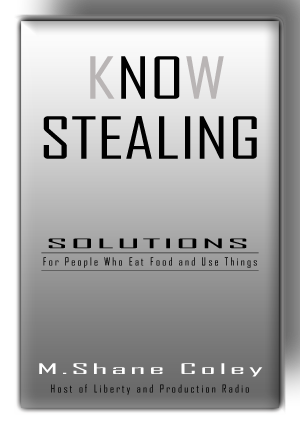
Know Stealing is the culmination of 15 years of research and 5 years of writing, learning more, digging deeper; always searching for the root causes of our problems as a state and nation. Know Stealing will replace preconceived notions with clear and precise knowledge capable of driving restoration in our American Republic. Because we live in a system designed to steal from every U.S. citizen, it is imperative that we KNOW stealing when it happens and learn what steps can be taken to prevent systemic theft from continuing into our future. Know Stealing provides the essential knowledge necessary to identify and understand the theft that is occurring in our nation every minute of every day. It also provides the solutions that we, as ordinary citizens, can utilize to begin enforcing a policy of NO stealing that will enable us to reclaim our Life, Liberty, Property, and Prosperity. We can no longer afford to tolerate the lies and the deception that are eroding our national economy and our freedoms. Armed with knowledge and the tools necessary to restore our nation, we can change the course of history.
Monday, January 23, 2012
Know Stealing - Tackles A Daunting Task
"Rarely does a book not only challenge, but revolutionize the manner in which you view the world. Upon finishing such works, it’s as if you’ve been given a lens so as to better identify the functions of society that are right in front of you, but have been too small to see. Frederic Bastiat’s classic, The Law comes to mind. Know Stealing is one such book. Shane Coley takes on the daunting task of explaining some of the most complex issues facing our world today and succeeds with a concise and astute brilliance. His solution, rooted in historical, economical and Biblical foundations is a single rule: No Stealing. His insights on the significance and protection of life, liberty and property are desperately needed and a pleasure to read." ~ Drew Martin, Columnist, RevoluTimes.com
Please read other reviews at Amazon.com
Saturday, January 21, 2012
Know Stealing Methodically Unravels Centuries Of Deceit
"Rarely is the written work able to methodically unravel centuries of deceit and to lay the thieving emperor bare for all to see. Know Stealing accomplishes this and more, offering a necessary corrective to the theft at the root of modern society. Such is the power of truth simply stated. Arm yourself with the ideas herein to become a true defender of liberty." ~ Christopher David, Candidate for Congress [CA-33]
Please read other reviews at Amazon.com
Wednesday, January 11, 2012
I'd buy a copy for all my friends if they owned kindles
"Lots of ideas in this book that I have had in my head for a while but don't have the skill to convey to others the way Mr. Coley does (and there's plenty here I hadn't thought of or didn't really understand too). As a previous reviewer stated, this book does an excellent job of getting to the core of our problems, and leaves me hopeful they can be solved." ~ Luke Albers (rockerZ71)
Read this review and others at Amazon.com
Read this review and others at Amazon.com
Monday, January 9, 2012
Know Stealing - A Must Read
"One piece of the puzzle at a time, Shane Coley gets to the root of the problems we face as a country, as a church, and as individuals. Know Stealing will challenge the way you think about terms and concepts such as money, production, law, and authority that you see and use everyday, but are the fundamental building blocks which our society needs to understand in order to 'know stealing' and in turn have a nation of 'no stealing.'" ~ Chris Oliver
Tuesday, December 27, 2011
Bastiat & Hazlitt
"If you liked The Law by Bastiat and Economics in One Lesson by Hazlitt then you will like this book. A book that explores the keys to understanding the way the world works - what money is- How we are stolen from by government and the way back to liberty." ~ John Barbour on Goodreads.comI am honored to be mentioned in the context of Frederic Bastiat and Henry Hazlitt. I hope to have occasion to meet Mr. Barbour someday and thank him in person for such kind words.
The Law and Economics In One Lesson are classics in the top of their categories and I highly recommend them. In fact, a friend and I gave away hundreds of copies of The Law during my 2010 Georgia State Senate campaign.
Monday, December 5, 2011
Know Stealing
Know Stealing is the culmination of 15 years of research and 5 years of writing, learning more, digging deeper, throwing material away and writing again, always searching for the root causes of our problems as a state and nation.
Know Stealing begins:
"A people or nation that does not understand liberty cannot defend it."
"I work late and rise early thinking about liberty, production and the nature of things. The stakes are high. Your time is valuable. Please permit me to be direct. We have been deceived, and I know how it was done.
The reader with an open mind, who actively questions everything, including the ideas recorded here, will get the most out of Know Stealing. When you reach the last page, it is my hope that you will have demanded, and that I will have delivered, solid arguments capable of standing under scrutiny and pressure."
Following are a few other excerpts from the introduction:
"... My single objective is to share the very best of what I've learned with those who are willing to open their minds and think, in order to understand how to restore and preserve our great nation as a land of liberty and production. I welcome all challenges with regard to these ideas."
"... The material in this book is powerful. It will teach a bold middle school student all that is necessary to debate and defeat a formally educated economist or an experienced politician. Imagine a magnificent skyscraper that is built on a lie. If a person, even a child, can show that the foundation is a lie, then the whole building has to be an illusion. Many things we believe are true are no more than illusions. Children who study the ideas presented in this book will have a better understanding of the world we live in than most successful and formally educated adults."
"... One of my challenges is to explain where we are wrong in our thinking without unnecessarily offending people. At the same time, I would debate any citizen, businessman, pastor, professor, teacher, leader, political activist, elected official or journalist on these ideas at any time, in any place. The bottom line is that our thinking is extremely mixed up and, in many important areas, just flat out wrong. The errors in our thinking and understanding are costing us our liberty, our homes, our jobs, our retirements and our children's future."
"... Liberty and prosperity are always at stake in every nation for every generation. Eventually bad decisions in the past force a generation to come to terms with the truth about what is necessary to sustain a free society. We are one of those generations. In our case, we can no longer naively depend on past production, new land, old-style immigration, industrialization, available cheap energy and paper wealth to maintain our standard of living."
Know Stealing will shatter preconceived notions and replace them with clear and precise knowledge which is capable of driving restoration in our American Republic in particular, and modern civilization in general. Clearly the preceding statement is bold, but it will hold up under honest critical review.
With wisdom, knowledge, understanding, courage and commitment, we can right the ship and restore prosperity in the United States in a matter of months. The same is true in any society that will genuinely defend individual life, liberty and property.
One of the principle goals of the book is to enable more people to Know Stealing, so that we can enforce a policy of No Stealing. Theft that goes undetected will never be stopped.
Know Stealing at Amazon.com
"A people or nation that does not understand liberty cannot defend it."
"I work late and rise early thinking about liberty, production and the nature of things. The stakes are high. Your time is valuable. Please permit me to be direct. We have been deceived, and I know how it was done.
The reader with an open mind, who actively questions everything, including the ideas recorded here, will get the most out of Know Stealing. When you reach the last page, it is my hope that you will have demanded, and that I will have delivered, solid arguments capable of standing under scrutiny and pressure."
Following are a few other excerpts from the introduction:
"... My single objective is to share the very best of what I've learned with those who are willing to open their minds and think, in order to understand how to restore and preserve our great nation as a land of liberty and production. I welcome all challenges with regard to these ideas."
"... The material in this book is powerful. It will teach a bold middle school student all that is necessary to debate and defeat a formally educated economist or an experienced politician. Imagine a magnificent skyscraper that is built on a lie. If a person, even a child, can show that the foundation is a lie, then the whole building has to be an illusion. Many things we believe are true are no more than illusions. Children who study the ideas presented in this book will have a better understanding of the world we live in than most successful and formally educated adults."
"... One of my challenges is to explain where we are wrong in our thinking without unnecessarily offending people. At the same time, I would debate any citizen, businessman, pastor, professor, teacher, leader, political activist, elected official or journalist on these ideas at any time, in any place. The bottom line is that our thinking is extremely mixed up and, in many important areas, just flat out wrong. The errors in our thinking and understanding are costing us our liberty, our homes, our jobs, our retirements and our children's future."
"... Liberty and prosperity are always at stake in every nation for every generation. Eventually bad decisions in the past force a generation to come to terms with the truth about what is necessary to sustain a free society. We are one of those generations. In our case, we can no longer naively depend on past production, new land, old-style immigration, industrialization, available cheap energy and paper wealth to maintain our standard of living."
###
Know Stealing will shatter preconceived notions and replace them with clear and precise knowledge which is capable of driving restoration in our American Republic in particular, and modern civilization in general. Clearly the preceding statement is bold, but it will hold up under honest critical review.
With wisdom, knowledge, understanding, courage and commitment, we can right the ship and restore prosperity in the United States in a matter of months. The same is true in any society that will genuinely defend individual life, liberty and property.
One of the principle goals of the book is to enable more people to Know Stealing, so that we can enforce a policy of No Stealing. Theft that goes undetected will never be stopped.
Know Stealing at Amazon.com
Thursday, August 25, 2011
Chambliss & Isakson - Clueless About The Fed
August 20, 2011 Gilmer County Georgia
Saxby Chamblis is clueless about the Federal Reserve System.
Our US Senators don't understand The Federal Reserve System, which happens to be the tool used to crush production and wealth among the working people of this country. Notice Isakson offered no corrections to the logically incoherent statements made by Chambliss.
I paraphrase here, but the video below presents their very own words...
First Senator Chambliss says:
"There is no question that the Federal Reserve has an inordinate amount of power"and
"We have got to stop printing money in Washington"
and
"Under the current law there is nothing we can do about it"
Then Chambliss states he read the Creature From Jekyll Island, which is a book that explains the secrecy surrounding the design of the Fed by the bankers. This excellent book also PLAINLY STATES that the name of the Federal Reserve Central Banking game is BAILOUT. Chambliss said:
"It scared the hell out of me when I read it too by the way!"
Then he agrees that the FED was created by the bankers in Georgia in 1910 stating:
"But [Jekyll Island in 1910 is] obviously where the Federal Reserve was created."
So far, the FED has too much power, congress can't do anything about it and the bankers designed/created the FED on Jekyll Island in 1910. It gets better.
Now Chambliss tells us that:
"Constitutionally there's alot of power given to the Federal Reserve"
"And you obviously have to change the Constitution to do anything about that."
So now the FED has too much power, congress can't do anything about it, the bankers designed/created the FED on Jekyll Island in 1910 and the US Constitution gives a lot of power to the FED and we have to change the Constitution to do anything about it. In other words, the bankers created the FED in 1910 AND the founders created the FED in 1787... But he's not done yet. There is more.
Next he tells us that
"there is also authority given to the Federal Reserve by Congress."
OK, so let me get this straight. The FED has too much power, congress can't do anything about it, the bankers designed/created the FED on Jekyll Island in 1910, the US Constitution gives a lot of power to the FED and we have to change the Constitution to do anything about it. In other words, the bankers created the FED in 1910 AND the founders created the FED in 1787 AND Congress gives authority to the Fed, BUT Congress can't take that same authority away from the FED.
The truth is this: The Federal Reserve Act was passed by Congress in 1913 and can be repealed or cancelled by congress anytime. They could do it today. The Federal Reserve is unconstitutional because Congress cannot delegate its authority to Coin money. It is unconstitutional because printing paper money is unconstitutional no matter who does it. In addition, paper money or debased currency causes theft and, last I checked, stealing is illegal. Unless you are the government.
Are we wrong to expect our US Senators to understand the insidious, destructive, unconstitutional, unlawful, pillaging central banking system which wipes out the savings and retirement of the middle class, enables unlimited government growth and comes straight out of the Communist Manifesto?
Monday, April 4, 2011
Tuesday, March 8, 2011
Bill Greene - HB3 Constitutional Tender Act
Coverdell Legislative Office Building (CLOB)
18 Capitol Square SW Atlanta, GA 30334
Monday, March 7 · 9:00am - 12:00pm
18 Capitol Square SW Atlanta, GA 30334
Atlanta, GA
Monday, March 7 · 9:00am - 12:00pm
Excellent job making the case by Dr. Bill Greene and Representative Bobby Franklin.
Monday, March 7, 2011
My Testimony - HB3 Constitutional Tender Act
Click here for the video and response from the committee.
Coverdell Legislative Office Building (CLOB)
18 Capitol Square SW Atlanta, GA 30334
Monday, March 7 · 9:00am - 12:00pm
Good morning. My name is Shane Coley.
Coverdell Legislative Office Building (CLOB)
18 Capitol Square SW Atlanta, GA 30334
Atlanta, GA
Monday, March 7 · 9:00am - 12:00pm
I have studied history and economics extensively. I was raised in the cattle business, I can operate or rebuild heavy equipment and I am a professional software architect. I am self-employed. I was recently a candidate for state Senate in the 47th District where I carried my home county. My positions here today match my positions during the campaign.
The laws of Georgia
The majority of the banking and finance committee members publicly claim to be Christian. Therefore, I will talk about some of the general constraints or limits of the Christian belief system, and then about secular belief regarding theft or stealing.
In at least nine places the Bible tells us about differing weights and differing measures. In at least four places the Bible says that differing weights and differing measures are an abomination to God. A Christian must not ignore this.
Here is an example of differing measure: Suppose I were in the market buying wheat and I had a basket marked one bushel, but the basket was secretly larger than one bushel. My oversized basket would enable me to steal part of your wheat.
Differing weights and differing measures deceptively cause theft, which is a violation of the Eighth Commandment, "You shall not steal".
Since 1971, the only way to create a new US dollar is to record an entry in a ledger of the Federal Reserve System, or in a ledger of your local bank. Producers have to work years for new Dollars that the bank creates instantly with the stroke of a key.
When new US dollars are created in this way, there is no new wealth created, but the purchasing power of all previously existing dollars is decreased. This is an example of using differing measures to steal labor and property from producers.
This is clearly, undeniably, objectively a form of theft. To support fiat or fractional money is to support theft.
Some claim that our money system makes us wealthy. This is false. Wealth is the result of production.
Many of us notice that People depend on Production. People eat food and use things. Food and things must be produced. Government Produces nothing and wastes much. Since people depend on production and government interferes with production, there is no way that government has any solutions for us. We must remember that every promise made by a government official has to be kept by a producer. There is no other way.
It is impossible to confiscate a loss. Only profits or capital from past production can be confiscated. It is logically impossible for the creation of new US Dollars to make us wealthy. If I had time, I would prove that creating costless money will first make us poorer and eventually crush our free society.
The reality is that the creation of costless money can only lead to the destruction of a free society.
For those who are not constrained by the Christian belief system, if you oppose theft then you must oppose creating new US dollars from nothing.
Please listen carefully to the following quote from an old banker.
“The few who understand the system, will either be so interested in its profits, or so dependent on its favors that there will be no opposition from that class. The great body of people, mentally incapable of comprehending the tremendous advantages will bear its burden without complaint.”
To the Christians and those who oppose stealing: I respectfully ask that you vote for the Constitutional Tender Act as a small step toward eliminating differing weights and differing measures and theft from our monetary system.
And finally, let’s recall a bit of what John Maynard Keynes wrote in 1919: “while [creating costless money] impoverishes many, it actually enriches some” and also “[Inflation] engages all the hidden forces of economic law on the side of destruction, and does it in a manner which not one man in a million is able to diagnose.”
To those members who hold stock in banks or have otherwise profited from the banking business: Since our loss is your gain, I respectfully ask that you recuse yourself from this vote and from the vote on the final bill.
Wednesday, February 23, 2011
Peach Pundit: Defending Theft, Displaying Ignorance
My response to: Let’s Just Get This Out of the Way on Peach Pundit
Fractional money creates no wealth, but it does decrease the purchasing power of the money already in existence, which producers have previously earned by labor and production. This is a form of theft. To support fractional money is to support theft.
People depend on production. Fractional money produces nothing. No new resources exist because a quantity of fractional money is created. People don’t eat, wear or find shelter in paper money.
Some argue there is not enough commodity “money” to support our economy. This is a false claim and suitable for those who accept propaganda and useful to those who understand how to use the paper money system to claim the labor and production of other people.
Keynes is the chief advocate or poster boy for this paper money system we have. He explained its purpose in 1919 in his book The Economic Consequences of the Peace:
“Lenin is said to have declared that the best way to destroy the capitalist system was to debauch the currency. By a continuing process of inflation, governments can confiscate, secretly and unobserved, an important part of the wealth of their citizens. By this method they not only confiscate, but they confiscate arbitrarily; and, while the process impoverishes many, it actually enriches some… Lenin was certainly right. There is no subtler, no surer means of overturning the existing basis of society than to debauch the currency. The process engages all the hidden forces of economic law on the side of destruction, and does it in a manner which not one man in a million is able to diagnose.”
Another old banker once rightly said:
“The few who understand the system, will either be so interested in its profits, or so dependent on its favors that there will be no opposition from that class. The great body of people, mentally incapable of comprehending the tremendous advantages will bear its burden without complaint.”
Fractional money is simply a sophisticated form of plunder. If fractional money is good for the country on its own merits, stop wasting bits and bytes with ad hominem blather. Make the case.
Begin by proving that fractional money does not systematically cause theft, benefiting the few at the expense of the many, or by presenting your case for supporting theft.
“If a nation expects to be ignorant and free in a state of civilization, it expects what never was and never will be.” Thomas Jefferson to Charles Yancey, 1816
Thursday, February 17, 2011
Production and The Prodigal Son
I recently taught a series of Sunday school lessons on the parable of the Prodigal Son, which is found in Luke chapter 15. The Sunday school material I used began by observing how deeply ingrained the parable of the Prodigal Son is in our Spiritual and literary traditions. It was noted that Shakespeare used plot points from the parable of the Prodigal Son in the Merchant of Venice and in Henry IV. Country music singer Hank Williams recorded a song called the Prodigal Son comparing the Prodigal's homecoming to the joys of heaven. The world's great Art museums contain many works featuring scenes from the Prodigal Son's experience. Of course we recognize terms like a wayward child being referred to as a prodigal son or daughter and we hear people talk about killing the fattened calf or riotous living. So the stories and the ideas of the prodigal son are very familiar in our traditions, culture and language.
In addition one can argue that this parable is the most richly detailed and personal of all the parables of Jesus. It is safe to say that everyone can relate to at least one of the three characters in the parable at sometime in their life.
Because of the details in this parable, many people seek complex symbolism, layers of meaning or hidden lessons which bend the rules of interpretation. We want to be very careful to focus on the plain meaning of Scripture and not invent our own meaning for the parable.
Our goal then, is to read the parable and observe the details that provide the framework for the story, so that we can understand the plain meaning of the passage. As I began to prepare my Sunday school lesson, a new facet of the details of the story came into my view. I noticed that there were many terms which were directly related to production. So class began with the study of how production fits into the parable. Our first task was to agree on a definition of production.
Production: Labor and resources combined to provide for needs and wants.
It was easy for us to recognize and agree that production is some form of gain or increase. Next we went through a series of questions to see if production was reasonable to consider in studying our Bible lesson. First we asked "Since people eat food and use things, do people depend on production?" The answer is obviously yes. Next we asked "Does our dependence on production influence our decisions?" Again the obvious answer is yes, with a good example being that we often go to work because we want to have food, clothing and shelter. Next we asked "Does our dependence on production challenge our morals?" Again the obvious answer was yes. Then we asked "As Christians, does our dependence on production challenge our obedience?" Again the clear answer was yes. Finally we asked "Who made us dependent on production?" As Christians we believe that God is our Creator, which means that God made us dependent on production.
So let's think about what we just observed. People eat food and use things which means that people depend on production. Our dependence on production influences our decisions, challenges our morals, challenges our obedience - all because God made things that way. (For those who do not believe that there is a creator, please explain how nothing and no one produced everything. I enjoy that debate.) There is no question that thinking about production while studying Scripture is a good idea.
There are more than 50 terms in the parable of the prodigal son which are related to production. In the passage which is pasted below you will see various terms in bold. These are terms related to production. For example the term give is meaningless unless there is something to give. The term share is meaningless unless there is something to divide. The term estate obviously refers to the property of the father. The term everything refers to all of the property belonging to the son. Journey is a term indirectly related to production because in order to take a journey one must have the resources to do so. Think of your vacation. Loose living is a term related to production, as we see in the parable when his resources are gone. Then we have the term enough bread. Bread is clearly related to production and enough communicates a quantity of production. Further down we see the terms music and dancing. Music flows from an instrument which would've been produced from profits which belonged to a producer. He was willing to use these profits to create a musical instrument because his more immediate needs of food shelter and clothing had been met. And of course dancing is something that typically involves music and is something that occurs among people who are in good spirits with full stomachs. We could go on and on looking at the terms, but we have sufficiently illustrated the reason that various terms are considered to be related to production.
Luke 15:11-32 And He said, “A man had two sons. “The younger of them said to his father, ‘Father, give me the share of the estate that falls to me.’ So he divided his wealth between them. “And not many days later, the younger son gathered everything together and went on a journey into a distant country, and there he squandered his estate with loose living. “Now when he had spent everything, a severe famine occurred in that country, and he began to be impoverished. “So he went and hired himself out to one of the citizens of that country, and he sent him into his fields to feed swine. “And he would have gladly filled his stomach with the pods that the swine were eating, and no one was giving anything to him. “But when he came to his senses, he said, ‘How many of my father’s hired men have more than enough bread, but I am dying here with hunger! ‘I will get up and go to my father, and will say to him, “Father, I have sinned against heaven, and in your sight; I am no longer worthy to be called your son; make me as one of your hired men.” ’ “So he got up and came to his father. But while he was still a long way off, his father saw him and felt compassion for him, and ran and embraced him and kissed him. “And the son said to him, ‘Father, I have sinned against heaven and in your sight; I am no longer worthy to be called your son.’ “But the father said to his slaves, ‘Quickly bring out the best robe and put it on him, and put a ring on his hand and sandals on his feet; and bring the fattened calf, kill it, and let us eat and celebrate; for this son of mine was dead and has come to life again; he was lost and has been found.’ And they began to celebrate. “Now his older son was in the field, and when he came and approached the house, he heard music and dancing. “And he summoned one of the servants and began inquiring what these things could be. “And he said to him, ‘Your brother has come, and your father has killed the fattened calf because he has received him back safe and sound.’ “But he became angry and was not willing to go in; and his father came out and began pleading with him. “But he answered and said to his father, ‘Look! For so many years I have been serving you and I have never neglected a command of yours; and yet you have never given me a young goat, so that I might celebrate with my friends; but when this son of yours came, who has devoured your wealth with prostitutes, you killed the fattened calf for him.’ “And he said to him, ‘Son, you have always been with me, and all that is mine is yours. ‘But we had to celebrate and rejoice, for this brother of yours was dead and has begun to live, and was lost and has been found.’ ” NASB95
As written above, I noticed that there were several terms related to production in the story of the prodigal son. After I went through the passage marking the terms that were related to production, it became clear that if these terms were removed there would be no story. So now we have this richly detailed parable which influences our traditions and culture and art, and which is meaningful to nearly every person in some way at some point in their life, and we find that if we remove terms related to production the story falls apart. To be very clear, I'm not saying that the truth of the story is lost, because truth exists apart from the story and apart from the framework used to tell the story. However, this parable relies heavily on the concepts of production to convey certain truth.
Our country today is sometimes called a welfare state, which means that there is a significant portion of our population that depends on welfare for food shelter and clothing. If the story of the prodigal son were told today in our country, it would go a little bit differently. After the younger son had squandered his wealth on loose living, he would've gone to the welfare office and signed up for his welfare check and food stamps. This would have kept him from "coming to his senses", thinking about the condition of the hired help on his father's estate, recognizing the error of his ways, repenting of his bad choices and bad attitude, confessing these to his father and ultimately being received back into the family.
The parable of the prodigal son tells us things about God the Father, about Jesus as Savior, about Christians as prodigal sons and daughters and about the religious people like the scribes and the Pharisees who approach God based on their works and confidence in themselves. This parable also tells us something about how God's natural order and natural law is used to draw people to truth.
A Christian is supposed to be led by the Spirit, not by the flesh. According to the Christian worldview, an unsaved person is led by the flesh rather than by the spirit.
A person who understands spiritual truth will filter the desires of his flesh through spiritual understanding. If a person who is led by the flesh is going to learn spiritual truth, his flesh sometimes has a role in leading him there. The parable of the prodigal son is an excellent example of how a hungry belly will bring a person to his senses. Therefore whether the flesh leads the spirit or the spirit leads the flesh, it is important that the flesh and the spirit move in the same direction and work together. With that thought in mind let's consider what happens if the flesh and the spirit go in different directions.
Based on my Christian worldview I believe that the God of the Bible is the creator of the universe and everything in it. I also believe that God is the ultimate producer, even going beyond production to the act of creation. I also believe that man is created in the image of God and, because God is a producer by nature, we also are producers by nature. However not everyone produces. So the question is, if people are by nature producers but are not always productive, how does a person feel when they are not productive? I agree that there are many people who are lazy and unproductive and have no desire to change, but what is going on inside? Consider the drug addict who is destroying his body. He is choosing temporary pleasure over the immediate and long-term health of his body. Likewise, people will choose to be lazy and unproductive even at the expense of the immediate and long-term effect on their spirit or the inner man.
When a person lives in such a way that he squanders the property that he has and does not work to replace it, he faces poverty and hunger. Poverty and hunger led the prodigal son back to his senses. If the prodigal son had been given just a little food and clothing and enough shelter to survive, chances are he would not have come to his senses, repented, confessed and been reconciled to his family. His inner man would've become corrupt and undergone decay, rather than healing.
Therefore if a Christian really loves other people he will never do anything to support the physical man in a way that will ultimately harm the spiritual man. Let's consider the passages from Scripture that will guide us in best serving the physical and the spiritual man.
2 Thessalonians 3:10 For even when we were with you, we used to give you this order: if anyone is not willing to work, then he is not to eat, either.
Proverbs 16:25-26 There is a way that appears to be right, but in the end it leads to death. 26 The appetite of laborers works for them; their hunger drives them on.
I want to consider one other point the parable. When the young son returned, his father hugged him around the neck and commanded his servants to bring a robe, a ring, and sandals for his young son. Each of these gifts has a significant meaning, but we are going to focus on the ring right now. In those days, that ring would have been a signet ring which gave the possessor a right called usufruct. Usufruct is a Latin term that literally means "use of the fruits" and it describes the legal right to use someone else's property at no cost, while reaping the fruits as though the property were your own. We can see that the young son lost his right to any further inheritance, but while his father was alive he was able to use a portion of his father's property in order to produce and begin building sufficient wealth to take care of his own future family. Scripture records that God told the children of Israel
In summary, we find that the parable of the prodigal son is heavily dependent on terms related to production. We observed that our decisions are influenced by our dependence on production and that our morals and obedience are challenged by our dependence on production. We also see the God made us dependent on production and that God's natural order will cause a hungry man to lead his inner man toward right-thinking, restoration and productive life. An empty belly can get the attention of a stubborn will when no amount of persuasion will work. This means that if we support a hungry man who is unwilling to work, we have set in motion an internal decay that cannot be halted or reversed, except if we get out of the way and let the physical man once again be subject to the natural order and his dependence on production.
If we subsidize bad behavior, we will get more of it. If we penalize production, we will get less of it. Bad behavior is destructive and unfruitful. People depend on production. Following is a chart that I've shared in other places which compares and contrasts the biblical social model and the social model we use today in our country. Compare the chart to what we have discovered about the prodigal son.

Monday, January 11, 2010
Banana Republic
Note the sarcasm...
The following is an excerpt from Taipan Daily.
Turbo Timmy’s Christmas Eve Coup
Justice Litle, Editorial Director, Taipan Publishing Group
Monday, January 11, 2010
"The AIG fiasco was just a warm-up. Turbo Timmy’s latest coup could wind up costing taxpayers trillions – and the country hardly noticed."
Banana Republic, Here We Come
"No, the reason to be excited now – if one is able to ride the paper gravy train, that is – is because the backroom deal makers have won. They have shown, with little room for doubt, that the government can and will do what it takes to rescue Wall Streeters at all costs... even if it means sacrificing the health of the real economy in true banana republic fashion.
And so why worry? Why worry if a tidal wave of “Alt-A” mortgage resets is coming? Why worry that current policies continue to starve the real economy of credit and jobs, while at the same time encouraging banks to hold back on loans and ramp up their trading desk activity?
There is no reason to worry, you see, because Washington has finally proven adept at taking care of its own. It no longer matters if the real economy goes to hell, because the Fed and Treasury’s access to funds is unlimited now! No matter what, planet paper will be first and foremost... no matter what, planet paper will be saved.
We have learned all the wrong lessons in spades. “Too big to fail” has worked... the culprits of the last crisis are now as big and bold as ever (on the risk-taking side if not the lending side)... bad policies (in regard to propping up the U.S. housing market) now have blank-check support... and we as taxpayers have handed over our fiscal birthright to Turbo Timmy for a mess of pottage without even knowing it.
One can almost forgive the crooked denizens of Washington and Wall Street for rubbing their hands together with glee. If American citizens are willing to tolerate this, perhaps they are willing tolerate anything. If the taxpayer, the hard worker, the honest saver, has not grown furious by now, perhaps he never will." -- Taipan Daily
Friday, January 1, 2010
Liberty Solution
Got liberty?
“None are more hopelessly enslaved than those who falsely believe they are free.“ ~ Johann Goethe
Want liberty?
People have to work to get it.
A few in our founders' generation did that.
We have been steadily giving it away ever since.
We have to work to get it back.
If we do our part, our children will be granted a special gift.
They can then work to keep it.
Knowledge is power.
Learn the truth about production.
Learn the truth about money.
Learn the truth about government.
Liberty Solution
Liberty, States Rights, Nullification
Thursday, December 31, 2009
Offended By Silence
Who else is OFFENDED that our leaders are either uninformed about the basic principles of government and production or that they are informed and refuse to stand and fulfill their oath of office?
When we talk about "getting things done" in politics, what do we mean? Are we describing someone who is able to maneuver and succeed in reaching a compromise?
That approach rewards the politician, not the people.
He or she may be rewarded, but as long as we retain the system that confiscates property and reduces production, the people lose.
Our founders warned us about this. Yet we sleep.
As long as the system is allowed to grow, seizing more power and crushing more liberty each year, the politicians are doing our state and citizens no good.
We all know government power and waste increase continually. And we all watch as our agriculture and industry disappear.
Leaders must quit claiming victory when we slow this train down, as it heads for the wall. We have to STOP it.
Some may say that the people will not cooperate and support those in office. I think that is true today, but there are two problems.
First, what the people do or don't do is no excuse for leaders to be ignorant or silent.
Second, we don't know what the people would do if they had leaders bold enough to lead and to teach about the root causes of the problems we face. We should not be surprised when people get tired of trying to solve visible effects rather than root causes.
Think about it:
We ask our soldiers to risk their lives and limbs.
Some of our politicians may sometimes consider risking a little bit of their "political capital".
Disgusting.
Yes, I am offended.
Wednesday, December 30, 2009
Job Creation - Open Letter - Senate Press
Dear Senator Pearson,
I like your Senate Press article today and I appreciate your service, first in your role as a Producer and then as a senator.
You wrote: “Raising taxes is no way to stimulate the economy in a downturn.”
I would expand the thought to say: “taxes are no way to stimulate the economy ever.”
Government intervention always reduces production. Prosperity follows production.
Reduced production equals reduced prosperity.
The factors that are undermining our ability to produce are systemic. We must find ways to reestablish genuine production in Georgia; our state and our home. This must include finding ways to insulate our production and population from the devaluation of the dollar.
We will be wise to begin by keeping all the dollars we possibly can in Georgia in the hands of the citizens, while encouraging the use of precious metals in indirect exchange. We should pass legislation that keeps Federal taxes remittances in Georgia, to be paid to the Federal government for the value of services it provides, which are in the proper purview of the Federal government, after adjusting for inflation of the money supply.
Let the government and those it favors suffer the consequences of inflation for a change, instead of the people.
The rights of sovereign states will not be enjoyed unless we actively claim those rights as people of strength, courage and conviction. We must take back what has been taken away, while we still have a little strength left.
Mainstream academic thought would consider this a foolish approach, but the mainstream academic thought on the subject of economics is laughable, so we should not expect mainstream thinkers to understand. Or if they do, they are thieves and cowards for advocating for the Keynesian style economic system that is designed to destroy capitalism, and therefore to destroy liberty.
Keynes wrote the following in 1919:
“Lenin is said to have declared that the best way to destroy the capitalist system was to debauch the currency. By a continuing process of inflation, governments can confiscate, secretly and unobserved, an important part of the wealth of their citizens. By this method they not only confiscate, but they confiscate arbitrarily; and, while the process impoverishes many, it actually enriches some… Lenin was certainly right. There is no subtler, no surer means of overturning the existing basis of society than to debauch the currency. The process engages all the hidden forces of economic law on the side of destruction, and does it in a manner which not one man in a million is able to diagnose.”
When one can logically and mathematically understand and illustrate that a particular system serves the purpose of illicit wealth transfer, which is accomplished via the use of differing weights and measures, one can judge that system to be morally wrong. Our American system fits that description.
When one reviews history, one discovers that these market interventions via currency debasement are always seeds of greater oppression that lead to collapse of the productive capacity of a nation, and eventually the collapse of the nation.
When one considers that people eat food and use things, one may notice that for a nation to prosper, it must produce.
In addition to producing the things which constitute necessities, a nation must produce things valued by other people and nations if it hopes to continue trading with producers in the future. Producers exchange with producers.
Exporting inflation and selling debt to finance US purchases of foreign production is not a sustainable system. When our dollars lose their decreed value, if we are not producing, we will not be able to care for ourselves, and we will have nothing to exchange with producers for what we need.
Senator Pearson, I thank you for your service. I hope to have the opportunity to help you and others shrink government and restore production in the state of Georgia, leading the way for the same unified outcome in other states.
We need strong liberty warriors who step up to the battle line with fire in their eyes and their belly because they understand that we have been had, duped, abused, pillaged…
We have allowed a system of theft and control of production to sap the strength from our people, state and nation. We should be ashamed and angry. This is war, whether we acknowledge it as such or not. Just ask the ex-farmer, ex-textile owner or great American worker who is losing purchasing power and property daily.
"I believe that banking institutions are more dangerous to our liberties than standing armies." ~ Thomas Jefferson
The American system rips our production, property, savings, investments and retirement from our weathered and worn hands, a little bit more everyday.
Productivity retained in the hands of producers is the solution.
Georgia Senators: Know the truth. Stand. Cross the battle line. Restore liberty and prosperity in Georgia.
Blessings,
Shane Coley
47th District Senate Candidate
http://www.shanecoley.us
Real Solutions for Real Life
Tuesday, December 29, 2009
Defining Production
I was challenged by a friend today to define PRODUCTION versus NON-PRODUCTION. It is an interesting question to answer concisely. There are intertwined value systems which must be touched on in order to reasonably define the concept.
First, we must recognize that Production necessarily involves subjective valuation of output. However, any attempt to define Production in terms of value would require innumerable variables and conditions presented with regard a specific individual. Even then, the individual would need to guess the value he would assign.
Therefore, we have no basis to define or classify Production versus Non-production in terms of value, since value is conditional and subjective. We will, however, touch on the concept of gain versus loss to round out the categories.
Production results from employing your resources to satisfy the needs or wants of yourself or others.
Non-production results from employing someone else’s resources to satisfy the needs or wants of yourself or others.
Note: For additional insight, please review the articles about costless money and wealth transfer.
Production
For example, if a person uses their time to operate an employer’s machine to achieve a certain output, this is productive on the part of both owners. The employee owns his time and the employer owns the machine.
If this activity results in gain, then capital increases. If this activity results in loss, then capital is diminished.
If the owner of capital can afford to continue the activity, and chooses to do so even while generating losses, then production is still occurring and the activity is subjectively worth the cost to the owner of capital.
This subjective value judgment may never change, even if the owner depletes all capital and is forced to cease the activity.
On the other hand, the owner of capital may cease the activity by choice before losing all his capital.
Thus, Production may result in gain or loss, but if loss, the loss will be limited by the capital of the owner.
Non-production
Non-production is the act of consuming resources to which the consumer has no right.
In order to own a resource, it must be received as a gift, be homesteaded, or be produced.
The only other method of acquiring property is theft.
Therefore, if property one claims ownership to came into one’s possession by theft, fraud, coercion or force, then to the extent that one’s production is dependent on that property, one is a Non-producer.
Suppose 30% of my output (or my receipts which can be exchanged for real property), owes its existence to property which was NOT homesteaded, received as a gift or produced. In that case, I am 30% Non-producer and 100% thief, since being a thief is not a graduated attribute.
Thus, Non-production may result in gain or loss, but if loss, the loss will NOT be limited by the current capital of the owner. The Non-producer will use the system to gain access to additional real property through legalized plunder.
Legalized Plunder
Following are fraudulent methods of wealth transfer which turn Producers into Non-producers of varying degrees.
Costless Money
Here is my view of costless money:
“Costless money production is the founding and enabling tool of stealth oppression, which is a cancer that eventually gives birth to open tyranny. Our ignorance of basic economic principles leaves us viewing effects as causes, while the causes always remain hidden from our mind's eye. We fund our own destruction while blaming each other for the pain caused by an ever present, yet unseen enemy.”
Costless money causes a wealth transfer, which is theft. In addition to the government itself, early users of large quantities of costless new money are prime offenders.
When inflating with costless money, the purpose of inflation is to use NEW MONEY to purchase REAL ASSETS at OLD PRICES, thereby causing a wealth transfer from the people who get the new money last, toward the people who get the new money first.
The poor and people on fixed incomes suffer most. They pay for the wealth transfer to Non-producers through loss of purchasing power.
Taxation
When taxes are collected from one group and given to another, we take from Producers and give to Non-producers.
Whenever someone gets something he didn’t work for, someone else worked for something he didn’t get.
Regulation
We are taught regulation protects us from big business. This is a fallacy.
In fact, regulation creates barriers to competition and barriers to entry in the marketplace. Prices are higher than they would otherwise be and quality is lower. This causes a wealth transfer through coercion and through the waste of the consumer’s capital by forcing the consumer to overpay for sub-standard products.
Litigation
Litigation is a bludgeon used by government and established business to suppress competition. In addition to creating barriers similar to regulation, frivolous litigation wastes resources which could have been used more efficiently, which then increases costs to consumers.
Summary
I will discuss this in greater detail another time. There are interesting implications that flow from these categories of Production versus Non-production.
Our liberty and prosperity depend on our understanding private property, honest exchange, production and non-production.
Sunday, December 6, 2009
The Government Can
Who can take your money, with a twinkle in their eye; Take it all away and give to some other guy... The government, The government can.
Shane Coley for State Senate
Subscribe to:
Posts (Atom)