Showing posts with label Freedom. Show all posts

Monday, January 9, 2012

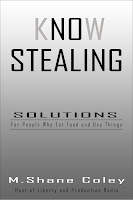
Know Stealing - A Must Read

"One piece of the puzzle at a time, Shane Coley gets to the root of the problems we face as a country, as a church, and as individuals. Know Stealing will challenge the way you think about terms and concepts such as money, production, law, and authority that you see and use everyday, but are the fundamental building blocks which our society needs to understand in order to 'know stealing' and in turn have a nation of 'no stealing.'" ~ Chris Oliver


Read this review and others at Amazon.com


Tuesday, December 27, 2011

Bastiat & Hazlitt

"If you liked The Law by Bastiat and Economics in One Lesson by Hazlitt then you will like this book. A book that explores the keys to understanding the way the world works - what money is- How we are stolen from by government and the way back to liberty." ~ John Barbour on Goodreads.com
I am honored to be mentioned in the context of Frederic Bastiat and Henry Hazlitt. I  hope to have occasion to meet Mr. Barbour someday and thank him in person for such kind words.

The Law and Economics In One Lesson are classics in the top of their categories and I highly recommend them. In fact, a friend and I gave away hundreds of copies of The Law during my 2010 Georgia State Senate campaign.


Monday, December 19, 2011

Revolutionary

"Shane Coley has succeeded in methodically correcting the most dangerous errors modern American society has in understanding economics, politics, government & Christian theology. A 15 year project with more to show for it than most entire lives. Transformational!"

Jimmy Norman
Executive Director
Georgians For Constitutional Government


Saturday, December 17, 2011

Read This Book

"If you are wondering where we have gone wrong as a country, then read this book. Shane Coley does a great job of getting to the very core of the problem. The media and talking heads we hear every day are so fixated on the symptoms that we forget to search for the root cause. This book peels the onion back layer by layer and explains in detail where the problem is. This book is a MUST read for anyone interested in restoring individual liberty in America!" ~ Clay Ortiz


Tuesday, March 29, 2011

How To Brainwash A Nation


How To Brainwash A Nation


This amazing interview was done back in 1985 by G Edward Griffin, author of The Creature From Jekyll Island, with a former KGB agent who was trained in subversion techniques. He explains the 4 basic steps to socially engineering entire generations into thinking and behaving the way those in power want them to. It's shocking because our nation has been transformed in the exact same way, and followed the exact same steps.

Thursday, March 10, 2011

Friday, February 25, 2011

Don't Just Cut the Budget; Cut the Propaganda


Tom Woods

Don't Just Cut the Budget; Cut the Propaganda


If a 6th grade understanding of government doesn't suit you anymore, watch this, then get a copy of Rollback by Tom Woods.


Sunday, April 4, 2010

It's Not About Healthcare


Obama finally got his way in the passage of a bill that has been decades in the making. Healthcare seems to be all that pops up on the news these days, but the debate was raging long before President Obama took office.

First came Hoover and FDR. Then the 1964 Democrat controlled Congress brought with it Medicare and Medicaid. These now have over 104 million combined beneficiaries. Former President Nixon supported a plan that required employers to provide a minimum level of insurance to employees. Healthcare as employee compensation to get around wage controls, set the stage for an unaccountable four-party health insurance market. In 1976, President Jimmy Carter called for a "comprehensive national health insurance system with universal and mandatory coverage" as a part of his campaign platform. Sound familiar?

For decades, our government has tried repeatedly to impose universal healthcare on citizens of the United States. ObamaCare is the socialized healthcare plan of the century, repackaged. It is not a new idea, and as history has proven, it is not a road America wants to go down. It will only bring more trouble, poverty and steady decline to our nation.

So, what is the healthcare debate really about? To understand the purpose of "healthcare", we must understand the principles of liberty and production - both vital parts of human society. People depend on production. Think about the things you use throughout the day: clothes, coffee, cars, or a microwave. Someone had to produce each item. Stop. Think. What would your day be like if you didn't have these things?

Each American is in some way dependent on the labor and property of another person - a producer. We all need the other guy to produce efficiently so the things we use will be abundant and cheap.

It makes sense then, that in order for individuals to prosper, someone must produce food, shelter, clothes, and all the other things we use. It also logically follows that people produce more good things when they are not hindered by force and confiscation of their profits, property and tools.

If you produce something using your own time and property, you don't want to give it up unless you get something that is useful in exchange. It really is that simple.

In other words, the strength of an individual or a nation is dependent on the quantity and quality of useful things it produces. If we want food, clothes, housing, cars, trucks or video games, we have to either produce those exact things or produce something to exchange with the producer of those things.

Are we producing anymore? Agricultural and industrial capacity in the United States is nearly destroyed. According to estimations by the United States Department of Labor, over 650,000 more manufacturing jobs will be gone by 2018. Farming and agriculture jobs are also expected to decline by 80,000.

How did this happen? Agriculture and industry made us strong and prosperous. For some reason, someone has been allowed to drive the farmer off his land and the manufacturer out of his factory. Most of them didn't want to leave. They were forced out.

We must understand that anything that interferes with the United States' ability to produce makes us poorer and weaker as a nation. Wealth redistribution, unwise regulation, burdens of litigation, constant inflation, barriers to voluntary association and barriers to voluntary exchange all reduce how much we are able to produce.

Eventually, this decline will leave us in poverty and helplessness as a nation.

Our retirements are devastated. Many people have been forced to delay or exit retirement altogether. Families are struggling against growing college tuition rates. Teachers all over northeast Georgia are taking more unpaid furlough days. This decline must be stopped.

To give our children any honest hope, we absolutely must learn to think in larger terms. The success and strength of Georgia will rise or fall with the success and strength of America. We must understand that the state has to stand up for the rights and property of our citizens in aggressive, proactive ways.

Our central government has been up to no good more often than not, since the founding of our nation. For example, according to Thomas Jefferson, Alexander Hamilton who was Washington's Treasury Secretary, swindled the people through conniving payment of federal and state war debts. His plan had the following two goals: To confuse the people and corrupt the legislature.

Jefferson concluded: "And with grief and shame it must be acknowledged that his machine was not without effect ; that even in this, the birth of our government, some members were found sordid enough to bend their duty to their interests, and to look after personal rather than public good."

The federal government is always looking for new ways to steal our property. Our ignorance of money and production is the strength of these tyrants.

Productivity retained in the hands of the producer is the solution.

So when we hear talk about the benefits of "Healthcare," "Cap and Trade," "Global Warming," "Bailouts" or other government actions, there is really only one question:

Will this government action help us produce more of the good things we use everyday in Georgia, leading to abundance, prosperity and strength?

Statistics, math, logic, history, current events, human nature, and even the Bible, all emphatically say... "No."

Blessings,

Shane Coley

Tuesday, January 26, 2010

The Misesian Vision


Shane says: "This is the most important speech you will read all year."

The Misesian Vision

Mises Daily: Monday, January 25, 2010 by Llewellyn H. Rockwell Jr.

[This talk was delivered at the Jeremy Davis Mises Circle in Houston, Texas, on January 23, 2010.]


I'm finding it ever more difficult to describe to people the kind of world that the Mises Institute would like to see, with the type of political order that Mises and the entire classical-liberal tradition believed would be most beneficial for mankind.

It would appear that the more liberty we lose, the less people are able to imagine how liberty might work. It's a fascinating thing to behold.

People can no longer imagine a world in which we could be secure without massive invasions of our privacy at every step, and even being strip searched before boarding airplanes, even though private institutions manage much greater security without any invasions of human rights.

People can no longer remember how a true free market in medical care would work, even though all the problems of the current system were created by government interventions in the first place.

People imagine that we need 700 military bases around the world and endless wars in the Middle East, for "security," though safe Switzerland doesn't.

People think it is insane to think of life without central banks, even though they are modern inventions that have destroyed currency after currency.

Even meddlesome agencies like the Consumer Products Safety Commission or the Federal Trade Commission strike most people as absolutely essential, even though it is not they who catch the thieves and frauds, but private institutions.

The idea of privatizing roads or water supplies sounds outlandish, even though we have a long history of both.

People even wonder how anyone would be educated in the absence of public schools, as if markets themselves didn't create in America the world's most literate society in the 18th and 19th centuries.

This list could go on and on. But the problem is that the capacity to imagine freedom — the very source of life for civilization and humanity itself — is being eroded in our society and culture. The less freedom we have, the less people are able to imagine what freedom feels like, and therefore the less they are willing to fight for its restoration.

This has profoundly affected the political culture. We've lived through regime after regime, since at least the 1930s, in which the word "freedom" has been a rhetorical principle only, even as each new regime has taken away ever more freedom.

Now we have a president who doesn't even bother to pay lip service to the idea of freedom. In fact, I don't think that the idea has occurred to Obama at all. If the idea of freedom has occurred to him, he must have rejected it as dangerous, or unfair, or unequal, or irresponsible, or something along those lines.

To him, and to many Americans, the goal of government is to be an extension of the personal values of those in charge. I saw a speech in which Obama was making a pitch for national service — the ghastly idea that government should steal 2 years of every young person's life for slave labor and to inculcate loyalty to the leviathan — with no concerns about setting back a young person's professional and personal life.

How did Obama justify his support of this idea? He said that when he was a young man, he learned important values from his period of community service. It helped form him and shape him. It helped him understand the troubles of others and think outside his own narrow experience.

Well, I'm happy for him. But he chose that path voluntarily. It is a gigantic leap to go from personal experience to forcing a vicious national plan on the entire country. His presumption here is really taken from the playbook of the totalitarian state: the father-leader will guide his children-citizens in the paths of righteousness, so that they all will become god like the leader himself.

To me, Obama's comment illustrates one of two things. It could show that Obama is a potential dictator in the mold of Stalin, Hitler, and Mao, for the presumptions he puts on exhibit here are just as frightening as any imagined by the worst tyrants in human history. Or, more plausibly, it may be an illustration of Hannah Arendt's view that totalitarianism is merely an application of the principle of the "banality of evil."

With this phrase, Arendt meant to draw attention to how people misunderstand the origin and nature of evil regimes. Evil regimes are not always the products of fanatics, paranoids, and sociopaths, though, of course, power breeds fanaticism, paranoia, and sociopathology. Instead, the total state can be built by ordinary people who accept a wrong premise concerning the role of the state in society.

If the role of the state is to ferret out evil thoughts and bad ideas, it must necessarily become totalitarian. If the goal of the state is that all citizens must come to hold the same values as the great leader, whether economic, moral, or cultural, the state must necessarily become totalitarian. If the people are led to believe that scarce resources are best channeled in a direction that producers and consumers would not choose on their own, the result must necessarily be central planning.

On the face of it, many people today do not necessarily reject these premises. No longer is the idea of a state-planned society seen as frightening. What scares people more today is the prospect of a society without a plan, which is to say a society of freedom. But here is the key difference between authority in everyday life — such as that exercised by a parent or a teacher or a pastor or a boss — and the power of the state: the state's edicts are always and everywhere enforced at the point of a gun.

"It begins in a seemingly small error, a banality. But, with the state, what begins in banality ends in bloodshed."


It is interesting how little we think about that reality — one virtually never hears that truth stated so plainly in a college classroom, for example — but it is the core reality. Everything done by the state is ultimately done by means of aggression, which is to say violence or the threat of violence against the innocent. The total state is really nothing but the continued extension of these statist means throughout every nook and cranny of economic and social life. Thus does the paranoia, megalomania, and fanaticism of the rulers become deadly dangerous to everyone.

It begins in a seemingly small error, a banality. But, with the state, what begins in banality ends in bloodshed.

Let me give another example of the banality of evil. Several decades ago, some crackpots had the idea that mankind's use of fossil fuels had a warming effect on the weather. Environmentalists were pretty fired up by the notion. So were many politicians. Economists were largely tongue-tied because they had long ago conceded that there are some public goods that the market can't handle; surely the weather is one of them.

Enough years go by, and what do you have? Politicians from all over the world — every last one of them a huckster of some sort, only pretending to represent his nation — gathering in a posh resort in Europe to tax the world and plan its weather down to precise temperatures half a century from now.

In the entire history of mankind, there has not been a more preposterous spectacle than this.

I don't know if it is tragedy or farce that the meeting on global warming came to an end with the politicians racing home to deal with snowstorms and record cold temperatures.

I draw attention to this absurdity to make a more general point. What seems to have escaped the current generation is the notion that was once called freedom.

Let me be clear on what I mean by freedom. I mean a social or political condition in which people exercise their own choices concerning what they do with their lives and property. People are permitted to trade and exchange goods and services without impediment or violent interference. They can associate or not associate with anyone of their own choosing. They can arrange their own lives and businesses. They can build, move, innovate, save, invest, and consume on terms that they themselves define.

What will be the results? We cannot predict them, any more than I can know when everyone in this room will wake up tomorrow morning, or what you will have for breakfast. Human choice works this way. There are as many patterns of human choice as there are humans who make choices.

The only real question we should ask is whether the results will be orderly — consistent with peace and prosperity — or chaotic, and thereby at war with human flourishing. The great burden born by the classical liberal tradition, stretching from medieval times to our own, is to make believable the otherwise improbable claim that liberty is the mother, not the daughter, of orderliness.

To be sure, that generation of Americans that seceded from British rule in the late-18th century took the imperative of liberty as a given. They had benefitted from centuries of intellectual work by true liberals who had demonstrated that government does nothing for society but divide and loot people in big and small ways. They had come to believe that the best way to rule a society is not to rule it at all, or, possibly, to rule it in only the most minimal way, with the people's consent.

"The political order in which we live is but an extension of the capacities of our collective cultural imagination."


Today, this social order sounds like chaos, not anything we dare try, lest we be overrun with terrorists and drug fiends, amidst massive social, economic, and cultural collapse. To me this is very interesting. It is the cultural condition that comes about in the absence of experience with freedom. More precisely, it comes about when people have no notion of the relationship between cause and effect in human affairs.

One might think that it would be enough for most people to log on to the World Wide Web, browse any major social-networking site or search engine, and gain direct experience with the results of human freedom. No government agency created Facebook and no government agency manages its day-to-day operation. It is the same with Google. Nor did a bureaucratic agency invent the miracle of the iPhone, or the utopian cornucopia of products available at the Wal-Mart down the street.

Meanwhile, look at what the state gives us: the Department of Motor Vehicles; the post office; spying on our emails and phone calls; full-body scans at the airport; restrictions on water use; the court system; wars; taxes; inflation; business regulations; public schools; Social Security; the CIA; and another ten thousand failed programs and bureaucracies, the reputations of which are no good no matter who you talk to.

Now, one might say, Oh sure, the free market gives us the dessert, but the government gives us the vegetables to keep us healthy. That view does not account for the horrific reality that more than 100 million people were slaughtered by the state in the 20th century alone, not including its wars.

This is only the most visible cost. As Frédéric Bastiat emphasized, the enormity of the costs of the state can only be discovered in considering its unseen costs: the inventions not brought to market, the businesses not opened, the people whose lives were cut short so that they could not enjoy their full potential, the wealth not used for productive purposes but rather taxed away, the capital accumulation through savings not undertaken because the currency was destroyed and the interest rate held near zero, among an infinitely expandable list of unknowns.

To understand these costs requires intellectual sophistication. To understand the more basic and immediate point, that markets work and the state does not, needs less sophistication but still requires some degree of understanding of cause and effect. If we lack this understanding, we go through life accepting whatever exists as a given. If there is wealth, there is wealth, and there is nothing else to know. If there is poverty, there is poverty, and we can know no more about it.

It was to address this deep ignorance that the discipline of economics was born in Spain and Italy — the homes of the first industrial revolutions — in the 14th and 15th centuries, and came to the heights of scientific exposition in the 16th century, to be expanded and elaborated upon in the 18th century in England and Germany, and in France in the 19th century, and finally to achieve its fullest presentation in Austria and America in the late-19th and 20th centuries.

And what did economics contribute to human sciences? What was the value that it added? It demonstrated the orderliness of the material world through a careful look at the operation of the price system and the forces that work to organize the production and distribution of scarce goods.

The main lesson of economics was taught again and again for centuries: government cannot improve on the results of human action achieved through voluntary trade and association. This was its contribution. This was its argument. This was its warning to every would-be social planner: your dreams of domination must be curbed.

In effect, this was a message of freedom, one that inspired revolution after revolution, each of which stemming from the conviction that humankind would be better off in the absence of rule than in its tyrannical presence. But consider what had to come before the real revolutions: there had to be this intellectual work that prepared the field of battle, the epic struggle that lasted centuries and continues to this day, between the nation-state and the market economy.

Make no mistake: it is this battle's outcome that is the most serious determinant in the establishment and preservation of freedom. The political order in which we live is but an extension of the capacities of our collective cultural imagination. Once we stop imagining freedom, it can vanish, and people won't even recognize that it is gone. Once it is gone, people can't imagine that they can or should get it back.

"Never miss an opportunity to tell the truth. Sometimes, thinking the unthinkable, saying the unsayable, teaching the unteachable, is what makes the difference between bondage and sweet liberty."


I'm reminded of the experience of an economist associated with the Mises Institute who was invited to Kazakhstan after the fall of the Soviet Union. He was to advise them on a transition to free markets. He talked to officials about privatization and stock markets and monetary reform. He suggested no regulations on business start-ups. The officials were fascinated. They had become convinced of the general case for free enterprise. They understood that socialism meant that officials were poor too.

And yet, an objection was raised. If people are permitted to open businesses and factories anywhere, and we close state-run factories, how can the state properly plan where people are going to live? After all, people might be tempted to move to places where there are good-paying jobs and away from places where there are no jobs.

The economist listened to this point. He nodded his head that this is precisely what people will do. After some time, the government officials became more explicit. They said that they could not simply step aside and let people move anywhere they want to move. This would mean losing track of the population. It could cause overpopulation in some areas and desolation in others. If the state went along with this idea of free movement, it might as well shut down completely, for it would effectively be relinquishing any and all control over people.

And so, in the end, the officials rejected the idea. The entire economic reform movement foundered on the fear of letting people move — a freedom that most everyone in the United States takes for granted, and which hardly ever gives rise to objection.

Now, we might laugh about this, but consider the problem from the point of view of the state. The whole reason you are in office is control. You are there to manage society. What you really and truly fear is that by relinquishing control of people's movement, you are effectively turning the whole of society over to the wiles of the mob. All order is lost. All security is gone. People make terrible mistakes with their lives. They blame the government for failing to control them. And then what happens? The regime loses power.

In the end, this is what it always comes down to for the state: the preservation of its own power. Everything it does, it does to secure its power and to forestall the diminution of its power. I submit to you that everything else you hear, in the end, is a cover for that fundamental motive.

And yet, this power requires the cooperation of public culture. The rationales for power must convince the citizens. This is why the state must be alert to the status of public opinion. This is also why the state must always encourage fear among the population about what life would be like in the absence of the state.

The political philosopher who did more than anyone else to make this possible was not Marx nor Keynes nor Strauss nor Rousseau. It was the 17th-century philosopher Thomas Hobbes, who laid out a compelling vision of the nightmare of life in the absence of the state. He described such life as "solitary, poor, nasty, brutish, and short." The natural society, he wrote, was a society of conflict and strife, a place in which no one is safe.

He was writing during the English Civil War, and his message seemed believable. But, of course, the conflicts in his time were not the result of natural society, but rather of the control of leviathan itself. So his theory of causation was skewed by circumstance, akin to watching a shipwreck and concluding that the natural and universal state of man is drowning.

And yet today, Hobbesianism is the common element of both left and right. To be sure, the fears are different, stemming from different sets of political values. The Left warns us that if we don't have leviathan, our front yards will be flooded from rising oceans, big business moguls will rob us blind, the poor will starve, the masses will be ignorant, and everything we buy will blow up and kill us. The Right warns that in the absence of leviathan, society will collapse in cesspools of immorality lorded over by swarthy terrorists preaching a heretical religion.

The goal of both the Left and Right is that we make our political choices based on these fears. It doesn't matter so much which package of fear you choose; what matters is that you support a state that purports to keep your nightmare from becoming a reality.

Is there an alternative to fear? Here is where matters become a bit more difficult. We must begin again to imagine that freedom itself could work. In order to do this, we must learn economics. We must come to understand history better. We must study the sciences of human action to relearn what Juan de Mariana, John Locke, Thomas Jefferson, Thomas Paine, Frédéric Bastiat, Ludwig von Mises, F.A. Hayek, Henry Hazlitt, Murray N. Rothbard, and the entire liberal tradition understood.

What they knew is the great secret of the ages: society contains within itself the capacity for self-management, and there is nothing that government can do to improve on the results of the voluntary association, exchange, creativity, and choices of every member of the human family.

If you know this lesson, if you believe this lesson, you are part of the great liberal tradition. You are also a threat to the regime, not only the one we live under currently, but every regime all over the world, in every time and place. In fact, the greatest guarantor of liberty is an entire population that is a relentless and daily threat to the regime precisely because they embrace the dream of liberty.

The best and only place to start is with yourself. This is the only person that you can really control in the end. And by believing in freedom yourself, you might have made the biggest contribution to civilization you could possibly make. After that, never miss an opportunity to tell the truth. Sometimes, thinking the unthinkable, saying the unsayable, teaching the unteachable, is what makes the difference between bondage and sweet liberty.

The title of this talk is "the Misesian vision." This was the vision of Ludwig von Mises and Murray N. Rothbard. It is the vision of the Mises Institute. It is the vision of every dissident intellectual who dared to stand up to despotism, in every age.

I challenge you to enter into the great struggle of history, and make sure that your days on this earth count for something truly important. It is this struggle that defines our contribution to this world. Freedom is the greatest gift that you can give yourself and all of humanity.

Llewellyn H. Rockwell, Jr. is chairman of the Ludwig von Mises Institute in Auburn, Alabama, editor of LewRockwell.com, and author of The Left, the Right, and the State.

This talk was delivered at the Jeremy Davis Mises Circle in Houston, Texas, on January 23, 2010.

Thursday, December 31, 2009

Offended By Silence


Who else is OFFENDED that our leaders are either uninformed about the basic principles of government and production or that they are informed and refuse to stand and fulfill their oath of office?

When we talk about "getting things done" in politics, what do we mean? Are we describing someone who is able to maneuver and succeed in reaching a compromise?

That approach rewards the politician, not the people.

He or she may be rewarded, but as long as we retain the system that confiscates property and reduces production, the people lose.

Our founders warned us about this. Yet we sleep.

As long as the system is allowed to grow, seizing more power and crushing more liberty each year, the politicians are doing our state and citizens no good.

We all know government power and waste increase continually. And we all watch as our agriculture and industry disappear.

Leaders must quit claiming victory when we slow this train down, as it heads for the wall. We have to STOP it.

Some may say that the people will not cooperate and support those in office. I think that is true today, but there are two problems.

First, what the people do or don't do is no excuse for leaders to be ignorant or silent.

Second, we don't know what the people would do if they had leaders bold enough to lead and to teach about the root causes of the problems we face. We should not be surprised when people get tired of trying to solve visible effects rather than root causes.

Think about it:

We ask our soldiers to risk their lives and limbs.

Some of our politicians may sometimes consider risking a little bit of their "political capital".

Disgusting.

Yes, I am offended.

Thank You For A Great Start!


I want to thank each of you who have shared your resources with me as I work to win a senate seat here in Georgia. I will be another voice of reason and courage in our state legislature.

There are good men and women who serve in our state government, but we must do more. We are facing real problems in Georgia. Someone must set the example by plainly speaking about these problems.

We have no more time for political games and leaders who refuse to take risks. I am looking forward to the days when I am able to cross swords with those who oppose plain truth. These people are stealing my children's future. And yours.

I have studied history, economics and other topics for well over a decade because I care deeply about our country. I have learned that we are being attacked from within by subversive forces whose power comes from our own labor, property and production. This is true. I will gladly debate anyone on the subject, any time and any place.

Beyond sending out letters and a few electronic messages, I have been reluctant to ask for campaign funds. The whole process troubles me. The only way I can be satisfied that a contribution is worthwhile is this:

The money we spend has been used, and will be used, to spread a message to the people in the 47th District, and beyond, which can secure our liberty and restore prosperity in our land. I have learned the truth about how our nation is being dismantled and I want to share this with my fellow citizens and legislators. I also want to argue for our liberty and prosperity on the floor of the senate and from the platform afforded a senator.

If this were a business, you might say I have a great product for sale:

The keys to restore liberty and prosperity.

I welcome the support of all who will help spread this message, whether by learning and teaching, directing people to our websites or helping pay the bills.

Thank you to all who have pitched in with time, talent or money. I am blessed, humbled and encouraged by the support.

I want to say a special public thank you to Mike and April Brown. Mike is in Afghanistan serving at the call of our nation. April is home taking care of four beautiful children. Together they share a strong faith in Jesus Christ. They have contributed regularly to this campaign and I am reminded each time how we abuse our military men and women and their families when we refuse to do all we can to defend liberty here at home.

I encourage you to join Mike and April in the fight for liberty. The Mike and April Brown's in our state should not have to spend themselves fighting abroad only to be left to do the same thing over again here at home.

We have already spent more than $18,000 in the campaign. If you want to join us, contributions before December 31 are a big help.

http://www.shanecoley.us/support.html

Blessings,

Shane

Saturday, December 12, 2009

When the economy turns around...


I hear politicians talk about "when the economy turns around", but these comments are based on simple-minded and naive "wishes".

So what will restore prosperity? What will "turn the economy around"?

We must understand that producers exchange with other producers.

As a nation, we have wrongly taught our people that labor is dishonorable.

We have exported our jobs. We have lost generational knowledge in agriculture. We have lost trade skills in industry. We have severely damaged the freedoms that foster small business entrepreneurs.

The time is coming when we can no longer exchange worthless paper for what other nations produce.

Why would a person give you their brand new oil, silver, wheat or lawnmower in exchange for a piece of worthless paper? Our dollar is quickly being recognized for what it is: a worthless piece of paper.

Prosperity follows production.

If you want to see the economy turn around then you must fight for production to be reestablished in our land. This is not optional. It must happen.

Men, we must defend our own production and our private property the same way we defend our wife and children.

We take care of our families by using things that are produced.

Productivity retained in the hands of the producer is the solution.

Its your property. Fight for it. Nothing else will do.


Wednesday, August 12, 2009

Shane Coley for Georgia Senate


Please visit the Shane Coley for Georgia Senate official website for more information.

FOR IMMEDIATE RELEASE:

Republican Shane Coley announces for State Senate Seat in 47th District

Winder, GA – August 5, 2009 – Shane Coley announced his candidacy for the Georgia state Senate today. He is seeking election in the 47th District which includes Barrow, Madison and Oglethorpe counties and portions of Clarke, Elbert, and Jackson counties. Senator Ralph Hudgens is not a candidate for re-election.

Coley, a conservative republican and native Georgian, is excited about bringing new energy and a non-political focus to the seat.

“Georgia needs bold leaders who understand the source of the problems facing our state,” Coley said. “We need fewer rules, less taxes, smaller government and more liberty.” Coley added that it was productive Georgians and not state officials that have made Georgia great. ...

Read the entire press release here.


Tuesday, July 14, 2009

Economic Terms in Scripture

Normally I would read the following list and ask the hearer to consider possible labels for the category.

So far, I have found agreement that economics is a suitable heading for the list.

Next I ask where the list was sourced. The answers are always reasonable and sometimes correct, since it really is just a guess. Some say economics books, dictionary or Scripture.

The answer is Scripture.

The third question follows the list.

Profit
Gain
Exchange
Bought
Price
Forfeit
Repay
Costly
Redeem
Ransom
Redemption
Cost
Inherit
Calculate
Enough
Wealth
Sell
Buy
Value
Debt
Certificate
Cancelled
Talents
Possessions
Debtor
Gift
Free
Forgive
Credited
Account
Due
Wages
Treasure
Deposit


What are the subtopics within Scripture from which these terms were drawn? Please read the list and answer for yourself before advancing.


The subtopics are salvation and the relationship between God and man.

Matthew 16:26-27 “For what will it profit a man if he gains the whole world and forfeits his soul? Or what will a man give in exchange for his soul? “For the Son of Man is going to come in the glory of His Father with His angels, and will then repay every man according to his deeds. NASB95

1 Corinthians 6:20 For you have been bought with a price: therefore glorify God in your body. NASB95

1 Corinthians 7:23 You were bought with a price; do not become slaves of men. NASB95

Psalm 49:5-9 Why should I fear in days of adversity, When the iniquity of my foes surrounds me, Even those who trust in their wealth And boast in the abundance of their riches? No man can by any means redeem his brother Or give to God a ransom for him— For the redemption of his soul is costly, And he should cease trying forever— That he should live on eternally, That he should not undergo decay. NASB95

Revelation 21:6-7 Then He said to me, “It is done. I am the Alpha and the Omega, the beginning and the end. I will give to the one who thirsts from the spring of the water of life without cost. “He who overcomes will inherit these things, and I will be his God and he will be My son. NASB95

Colossians 2:2 that their hearts may be encouraged, having been knit together in love, and attaining to all the wealth that comes from the full assurance of understanding, resulting in a true knowledge of God’s mystery, that is, Christ Himself, NASB95

Luke 14:27-29 “Whoever does not carry his own cross and come after Me cannot be My disciple. “For which one of you, when he wants to build a tower, does not first sit down and calculate the cost to see if he has enough to complete it? “Otherwise, when he has laid a foundation and is not able to finish, all who observe it begin to ridicule him, NASB95

Matthew 13:44-46 “The kingdom of heaven is like a treasure hidden in the field, which a man found and hid again; and from joy over it he goes and sells all that he has and buys that field. “Again, the kingdom of heaven is like a merchant seeking fine pearls, and upon finding one pearl of great value, he went and sold all that he had and bought it. NASB95

Colossians 2:14 having canceled out the certificate of debt consisting of decrees against us, which was hostile to us; and He has taken it out of the way, having nailed it to the cross. NASB95

Matthew 6:12 ‘And forgive us our debts, as we also have forgiven our debtors. NASB95

Matthew 25:14-15 “For it is just like a man about to go on a journey, who called his own slaves and entrusted his possessions to them. “To one he gave five talents, to another, two, and to another, one, each according to his own ability; and he went on his journey. NASB95

Romans 6:23 For the wages of sin is death, but the free gift of God is eternal life in Christ Jesus our Lord. NASB95

Romans 4:3-9 For what does the Scripture say? “Abraham believed God, and it was credited to him as righteousness.” Now to the one who works, his wage is not credited as a favor, but as what is due. But to the one who does not work, but believes in Him who justifies the ungodly, his faith is credited as righteousness, just as David also speaks of the blessing on the man to whom God credits righteousness apart from works: Blessed are those whose lawless deeds have been forgiven, And whose sins have been covered. Blessed is the man whose sin the Lord will not take into account.” Is this blessing then on the circumcised, or on the uncircumcised also? For we say, “Faith was credited to Abraham as righteousness.” NASB95

2 Timothy 1:14 Guard, through the Holy Spirit who dwells in us, the treasure which has been entrusted to you. NASB95

2 Timothy 1:14 By the Holy Spirit who dwells within us, guard the good deposit entrusted to you. ESV


Much can be said about this economic correlation to spiritual and eternal things in Scripture. The implications are far reaching. It seems to me that in order to understand God's view of economics in spiritual matters, we must have a correct temporal view of economics.

I will save other commentary and illustrations for another time.

How to spot Natural Money


Natural money has at least the following two attributes:

  1. If the substance or thing were never again used or accepted as money beginning right this instant, it would still have at least one other practical, productive use.
  2. The Productivity Filter CANNOT be bypassed in bringing the substance or thing to market.

For instance, if US Dollars (which we know are costless to produce) were not accepted as money any longer, they would be useless.

Even though Gold and Silver have been outlawed as money, they continue to be mined and used.

Great nations are built and stand on natural money.

Costless money is a burden, indeed a cancer, no nation has the strength to bear.

Costless money causes us to fund our own destruction.

When we support costless money or fail to understand and defend natural money, we actually have chosen to give up Liberty in exchange for certain tyranny.


Thursday, July 9, 2009

Tales of Titans and Hobbits


Tales of Titans and Hobbits - Mises

Mises Daily by Juliusz Jablecki | Posted on 7/9/2007 12:00:00 AM

Literature can exert a powerful influence on our ideological views.[1]

Ayn Rand, after all, was primarily a novelist. Many people were converted to liberalism (or at least some variety of it) after experiencing in person her unquestionable charisma and magnetism, but the significance of her novels, most notably Atlas Shrugged,[2] can hardly be overlooked.

Indeed, it is only having read that expressive story that many future libertarians — among them Walter Block[3] — once and for all denounced socialism along with all the physical and mental bondage which it ineluctably imposes upon people. Hence, it was a narrative — a novel or, if you want, a fairy tale — that had managed to shape and contextualize the readers' notion of such abstract matters as freedom, l'étatism, or egalitarianism.

Another novelist who also managed to gain an exceptionally wide circle of readers and admirers was John Ronald Reuel Tolkien, the author of a worldwide bestseller The Lord of the Rings.[4] Even though Tolkien's style of writing was much less obtrusive than Rand's — he never forced upon his readers any particular reading of his book, and he overtly disliked conscious and intentional allegories — the English novelist never denied that his work concerns something more than just elves or dwarves, or that it deals with certain ideas. As he wrote to Michael Straight, the editor of New Republic, The Lord of the Rings was meant to succeed first of all as an exciting and moving tale — but a tale addressed primarily to adults, involving something more than mere chase and escape, namely some reflection of the writer's own views and values.[5]

Since Tolkien considered himself a conservative anarchist,[6] it should come as no surprise that while trying to answer his publisher's questions regarding the symbolism hidden in his magnum opus, he suggested to "…make the Ring into an allegory of our own time… an allegory of the inevitable fate that waits for all attempts to defeat evil power by power."[7]

Therefore, even though Tolkien's saga is all too often interpreted as an apolitical "road novel" or "picaresque novel for children," The Lord of the Rings could very well be the source of unending inspiration for libertarians as a belletristic dramatization of Lord Acton's famous statement that power tends to corrupt and absolute power corrupts absolutely.

Both Rand and Tolkien, then, passionately tell their tales about freedom, but they resort to completely different aesthetics, and, in consequence, paint two entirely different pictures of the world, with different heroes and different challenges. Are those differences important? How do they affect the "moral" of the respective tales? Given that it is of utmost importance just what kind of story one tells, it is perhaps worthwhile to reflect upon the different world images depicted in Atlas Shrugged and The Lord of the Rings, comparing the characters of both narratives along with the predicaments they face, and asking the fundamental question, which of the two novels constitutes a better context, a better literary frame of reference for freedom and Hans-Hermann Hoppe's idea of natural order?[8]

The Titans

Atlas Shrugged is, shortly put, a story of a strike, although not an ordinary one.[9] Rand does not write about labor unions or working masses, but about titans whose irreplaceable work, like that of their Greek predecessor Atlas, keeps the world alive. Titans are big capitalists, owners of ironworks and mines, men of genius, people who are creative and in every respect outstanding. Such is also the main character of the novel, Dagny Taggart, the heiress to the huge railroad company Taggart Transcontinental, which she desperately strives to save against ever more impudent government attempts to lay hands on her fortune. The society in which the heroine lives is dull, envious, lazy, essentially quite helpless, and were it not for the handful of Atlases, it would have definitely plunged into despair.

Dagny loves what she does for a living. She is an extremely talented railroad executive, and directing the whole enterprise seems not to tire her at all. The real burden for her is not work itself, but the necessity — the legal obligation — to share its plentiful fruits with the rest of society — the ungrateful mob of losers. Initially, the situation, though harsh, seems bearable, mainly because the heroine carries on with all her everyday duties with the relieving thought in mind that she is not alone, that other great achievers feel and think similarly, and though they may be outnumbered, they constitute the real engine of the world.

Gradually, however, Dagny realizes that the very engine of which she considered herself a part has been abruptly turned off and the titans, one after another, seem to be disappearing. The kidnapper turns out to be John Galt — a mysterious, legendary hero, whose name elicits expressions of helplessness among the losers:

"How should I deal with it?" asks one frightfully mediocre worker.

"How should I know?" is the invariable, dull reply. "Who is John Galt?"

Galt used to be one of the titans, but greed, collectivist bias, and ingratitude from the society to which he had given so much in the past have induced him to go on strike — not to fight with the oppressive system, not even to try to change it, but simply to leave, taking others along. And so they go, one by one: the great composers, innovators, creators, directors, owners… As a result, the engine of the world stops, and the economy plunges into chaos, for when there is no one to prey upon, the society of insatiable vultures no longer knows what to do.

The Übermenschen find refuge in an extraordinary valley hidden somewhere in Colorado, where the dollar sign does not stand — as on the "other side" — for greed, bribery, and sneakiness, but instead symbolizes success, skillfulness, and creative powers. The one and only unforgivable sin there is altruism. So they live, far from the dying world, bound by a promise that never again will they let unproductive loafers gain from their work.

They await the end of history, the moment when

the creed of self-immolation has run, for once, its undisguised course — when men find no victims ready to obstruct the path of justice and to deflect the fall of retribution on themselves, when the preachers of self-sacrifice discover that those who are willing to practice it, have nothing to sacrifice, and those who have, are not willing any longer — when men see that neither their hearts nor their muscles can save them, but the mind they damned is not there to answer their screams for help… when they have no pretense of authority left, no remnant of law, no trace of morality, no hope, no food and no way to obtain it — when they collapse and the road is clear….[10]
Then the titans will once more lift the Earth — all the superior individuals will come back to rebuild the world.

The Hobbits

Tolkien's novel also ends with a theme of rebuilding the world, a promise of setting things straight, bringing back the right order of things. It begins, however, in an entirely different way: not on the platform of a huge railway station, nor in a big factory, nor in a beautiful palace. The Lord of the Rings begins in the Shire — more precisely in Hobbiton, a small village peopled by hobbits, unobtrusive, somewhat clumsy, little creatures, whose straightforward and rather friendly nature makes them very similar to humans.

One day a great magician, Gandalf the Grey, pays a visit to the village. He is concerned by the fact that one of the hobbits, a certain Mr. Bilbo Baggins, keeps there hidden a precious artifact — a mysterious ring. Forged many years ago by Sauron, the Lord of Darkness, the Ring of Power is one of many rings of power, the one, however, that controls all the others. It has apparently found its way to Hobbiton by mere chance, as Bilbo brought it with him from one his journeys, hoping to hide it there from the rest of the world, adoring its gleam and magnificence.

The ring would give Bilbo strength and vitality, unusual in his advanced age, but it would also make him dependent on the ring itself. Before he knew it, the old hobbit became a serf of the Ring of Power, never daring to part with it, he would always keep it in a pocket of his ornamental waistcoat. This state of affairs would have probably gone on for many long years had Gandalf not learned the mysterious history of the ring, and recognized its true dark nature. Gandalf understood that Sauron knew very well where to look for his long lost precious treasure, and would inevitably claim it.

The ring cannot, however, go back to its creator, since it would mean the destruction of the whole Middle-earth and slavery of all peoples inhabiting it — darkness would fall over the once wonderful world, covering the horizon with a veil of smoke. Unfortunately, that mighty source of power cannot simply be buried or hidden, since the ring itself tries to return to its master who surely will not spare strength or efforts to regain rule over the world.

Thus, the only way to save Middle-earth seems to be to destroy the damned ring. Easy as it may seem, the task is in fact extremely difficult, for being a magic artifact, it will not yield to ordinary flames or any smith's hammer — it can only be thrown into the fire of Mordor in the Cracks of Doom. First, however, somebody must take it there. This will not be easy, since the road is guarded by Sauron's soldiers, the ugly, ruthless orcs.

It might seem that only Gandalf himself or one of the great and noble knights of Middle-earth could undertake such a dangerous quest. Unfortunately, to the extent that the Ring of Power gives its bearer strength to rule the world, it also overcomes him. It is an entity whose nature is to control everyone and everything. Thus, if the ring were to be worn by Gandalf or any other of the great heroes, it would become a terrifying implement of destruction, since anyone who slips it on his finger stops being himself and becomes instead a mere servent to the ring.

Only someone so mediocre, so weak, inept, and created seemingly for the sole purpose of minding his own merry business like Frodo Baggins — Bilbo's heir — could, at least to some extent, resist the evil power. Not clearly knowing what awaits him, Frodo sets upon his mission accompanied by a few friends from the Shire along with the distinguished knights of other races: Gimli the Dwarf; Legolas the Elf; two men, Aragorn and Boromir; and wise Gandalf himself.

Many times, the long journey puts Frodo's immunity to the test, showing that even such a moderate creature as himself cannot always resist the power of darkness. Once the ring eventually gets thrown into the abyss of Mordor, the sun rises again over Middle-earth, everything can be started anew, and the old world order is restored — without replacing the defeated power by a new, more sinister one.

How to Fight the System

These summaries might suggest that since the story told in The Lord of the Rings takes place in a fictitious world, while Atlas Shrugged describes a real-life situation, it is Rand's novel that does a better job of dramatizing the libertarian creed. Nevertheless, even though Tolkien creates his own world, different from the one we see around us each day, he meant the characters, the heroes of the war for Middle-earth, to be just as real as, say, the pygmies of the African jungle.[11]

Legolas, Aragorn, and Gimli are all characters created for the purpose of storytelling, but this does not change the fact that they are exemplifications of definite truths, principles, and values — as are Rand's characters, John Galt and Dagny Taggart. It does not matter whether one fights to defend Hobbiton or Taggart Transcontinental. In their most profound, most significant message, the two novels essentially talk about the same things — about challenges that a man must face, about his moral responsibility for himself and for all that he loves, and about the captivating and destructive influence of power and coercion.

Moreover, both novels clearly denounce the so-called imperative of action, that is, the belief that a system can easily be changed from within. It is plainly described in Atlas Shrugged, where the main characters express their opposition to the wickedness of the world by simply running away from it, confirming with their deeds the famous dictum of Etienne de la Boétie: "Resolve to serve no more, and you are at once freed."[12]

Even though in The Lord of the Rings it is an active fight and not passive resistance that forms the central theme of the novel, the fight is fought outside the system. Gandalf and Galadriel, both of great powers, consciously reject the possibility of defeating Sauron with the ring — they know very well that it would turn them into tyrants themselves.[13] The Lord of Darkness can only be defeated by destroying that which constitutes the very essence of his might — the Ring of Power.

Those similarities do not imply that there are no differences between Atlas Shrugged and The Lord of the Rings. Quite to the contrary — differences exist and they are the very reason why one of the novels serves better as a contextualization of the idea of natural order. To see this, we shall turn to the dissimilar structure of worlds and characters in both novels.

In Atlas Shrugged, for example, it is hard not to notice that somebody drives the world, maintains the reality in order, and without him everything would plunge into chaos. Clearly, that mysterious entity is not the state apparatus — rightly described as a machinery of exploitation — but a group of exceptional individuals who have simply created civilization — radio, television, central heating, music, law and order, etc. Luckily, the Übermenschen are benevolent and have no evil intentions vis-à-vis ordinary people. They wish neither to exploit, rule, nor control the rest of the society, but rather to impose upon it their rational project of "enlightenment" — they want to make use of their genius and bring prosperity and comfort to all.

It is totally different in The Lord of the Rings, where there is no "great plan for the world"; Middle-earth is inhabited by many different races — elves, dwarves, hobbits, men, ents, etc. — who all live, albeit separately, in tolerance, sometimes even friendship, but as a rule not interfering with each other. There is no government, central or local,[14] no industrial revolution and no uniform vision of progress or future. Even in the face of a terrible war, it is extremely hard to create a coalition against Sauron.

The world in Tolkien's novel is simply divided, decentralized to the extreme; beautiful in the diversity of various races, peoples, languages and outlooks — that is why no such thing as a "plan for humanity" could ever arise there as something good. There are, however, millions of smaller plans — for living through a harsh winter, for cultivating one's garden, for drinking a pint of beer in a local inn — drafted by millions of distinct individuals. The only unified vision that appears in the book is Sauron's plan; and let us not forget that Sauron stands for "an incarnation of Evil."[15]

It is instructive to compare also the main characters of the two novels. In Atlas Shrugged they are exceptional and it is precisely because of that quality that they became characters of the novel. Each of the Atlases is unblemished, pure, proud. Every detail of their physiognomy speaks of genius and magnificence. The Übermenschen do not simply move: they make motions full of charm and elegance. They do not simply work: they craft, always with passion and enthusiasm. They never get tired, weary or bored with what they do; they have no families, no children, no obligations; they are frightfully rational; they live only for themselves and for their occupational passions. If they happen to be businessmen, they never own little family businesses; they run huge corporations, ironworks, mines, or railway companies. In Rand's novel there is no place for moderation and inconspicuousness. Only that which is huge and effective deserves praise and attention.

Completely different, more human-like, are Tolkien's characters. In fact, the whole novel — though told from the hobbit's perspective — has a profoundly anthropocentric dimension. There are men in The Lord of the Rings, to be sure, but it is the hobbits who resemble real humans the most — they are rather clumsy, neither exceptionally smart, stout, nor courageous, but good, sociable, faithful and generally cheerful. The most important characters in Tolkien's novel are actually anti-heroes — they try to stay away from the world of big politics; however, when fate throws them in its very middle, they act bravely and ultimately bring salvation.

What the author of The Lord of the Rings seems to be saying, then, is that it is not titans who support the earth, but hobbits; each and every one of us, therefore, can answer the call of greatness and novelty, even should he live in Hobbiton spending most of his time cultivating his garden, smoking a pipe, and drinking beer in the local pub.

Every one of us struggles daily with the Saurons of his life, and maybe it is precisely those little triumphs that make the world a better place. As for respect and praise, it is not the directors of big corporations who deserve it the most — since, by the very nature of things, they are much too close to the ring — but those who, using only their own modest resources, earn their living by running little shops, kiosks, and family businesses. In those places one can sometimes still find the real, healthy spirit of capitalism. No wonder, then, that the Eye of Mordor constantly looks in their direction.

Conclusion

Given the breadth and length of both novels, the comparison of Atlas Shrugged and The Lord of the Rings could go on much longer, revealing many new themes and interpretations. It seems, however, that even the few differences sketched above allow for a tentative answer to the questions raised in the introduction. As much as Ayn Rand's novel, with its strictly modernist message, could have been at some point in the past an effective remedy against the plagues of socialism and collectivism, the world described in it does not fit today's reality and does not help in introducing the idea of natural order. Today, it is no longer necessary to protect big business from people. On the contrary, it is people who need protection from big business, which now goes hand in hand with Leviathan in trying to create a homogenous and completely atomized society.

The Lord of the Rings shows not only the great danger associated with all attempts to defeat evil power by power, but it also teaches that collectives do not really exist, that every one of us is the hero of his own individual story, and that law and order can easily exist without the state. Despite its egoistic message, Atlas Shrugged is full of imperatives to act, to fight, to bring salvation. Rand's characters suffer not only because the state reaches into their wallets, but because the society rejected their rational, "enlightened" vision of what is good and right.

Tolkien, on the other hand, disliked such imperatives. He hated the outlook that if something can be done, it has to be done, and once even admitted that the greatest deeds of mind and spirit are born in abnegation.[16] That is most likely the reason his characters do not look for great challenges, nor wish to change the world, and instead live quietly, fulfilling Voltaire's dictum Il faut cultiver notre jardin.

This is what makes The Lord of the Rings a much better means for conceptualizing the ideas of freedom than Atlas Shrugged. Reading Tolkien helps realize that, even after the "end of history," the world and society can move in the direction of Merry Old England rather than a soulless homogenized mass of atoms. Moreover, The Lord of the Rings conveys an extremely important and optimistic message, namely that a plurality of many different cultures, languages, societies and visions, all existing together, yet separate and independent of each other, is still viable — not in a democratic regime, but in the new world of Hoppean natural order.

Juliusz Jablecki is summer fellow at the Mises Institute, and works with the Mises Institute, Poland. Send him mail. Comment on the blog.

Notes

[1] This fact has been brilliantly captured by Jerome Tuccille who entitled his book on the birth and evolution of the libertarian movement It Usually Begins with Ayn Rand, Fox and Wilkes, 1997.

[2] Ayn Rand, Atlas Shrugged, Penguin Books, London, 1992.

[3] See Walter Block, "On Autobiography."

[4] J.R.R. Tolkien, The Lord of the Rings, HarperCollins Publishers, London, 2005.

[5] The Letters of J.R.R. Tolkien, Humphrey Carpenter ed., HarperCollins, London 2006, p. 233.

[6] He wrote: "My political opinions lean more and more to Anarchy (philosophically understood, meaning abolition of control not whiskered men with bombs) — or to »unconstitutional« Monarchy. I would arrest anybody who uses the word state (in any sense other than the inanimate realm of England and its inhabitants, a thing that has neither power, rights nor mind); and after a chance of recantation, execute them if they remained obstinate!"; see The Letters…, p. 63.

[7] The Letters…, p. 121.

[8] For a detailed, socio-economic treatment of the idea of natural order see e.g. Hans-Hermann Hoppe, Democracy: The God That Failed, Transaction Publishers, Rutgers, NJ, 2001.

[9] Indeed, "The Strike" was meant to be the title of the novel; see Leonard Peikoff's introduction to the cited edition of the book.

[10] Atlas Shrugged, p. 686–687.

[11] See The Letters…, p. 233.

[12] Etienne de la Boétie, The Politics of Obedience: The Discourse of Voluntary Servitude (PDF), p. 48.

[13] Thus, Gandalf cries: "No! With that power I should have power too great and terrible. And over me the Ring would gain a power still greater and more deadly! Do not tempt me! For I do not wish to become like the Dark Lord himself. Yet the way of the Ring to my heart is by pity, pity for weakness and the desire of strength to do good. Do not tempt me! I dare not take it, not even to keep it safe, unused." See The Lord…, p. 61.

[14] See The Lord…., p. 9–10; The Letters…, p. 272.

[15] The Letters…, pp. 151, 154.

[16] The Letters…, p. 246.

Monday, July 6, 2009

Benefits of Natural Money


Following is a simple but powerful chart that explains a key difference between the Austrian School of economics and the Keynesian School of economics. (I cringe when using the label "Keynesian School of economics", since it is actually a political ideology with no basis in economics, except in terms of destruction.)

What we are looking at is the way that each system views Private Property and Time.

Note: To be more brief and direct, I will ascribe positions to the Austrian School based on my own interpretation. To get a full spectrum of Austrian views, refer to the vast library of materials on the subject.


First let's briefly look at Private Property.

Austrian View

The Austrian School holds that Private Property is inseparable from Liberty.

Therefore, a just economic system will not include any scheme that forces a person to work in order to retain his private property.

Keynesian View

In the Keynesian system, property tax essentially makes a person a tenant on government property. If the present owner does not produce enough to pay the tax, the government takes the property away and assigns it to a serf, I mean citizen, who will produce enough to pay the tax.

The Keynesian system is designed to allocate property based on production. The state is to be the beneficiary of the productivity of the property manager.

(We sometimes think of the Keynesian property manager as an "owner", but a true Keynesian never does. A Keynesian knows a serf when he sees one.)

Next let's briefly look at Time.

Austrian View

The Austrian School recognizes that people are more prosperous based on quantity, quality and efficiency of production. The more people produce, the more prosperous the society becomes.

It really is a simple idea. Produce more, have more.

In simple terms, to be more productive, we use machines.

Machines enter the production system through innovation, engineering, testing, manufacturing and deployment.

In order to bring a more efficient machine into the production process, one will need to use capital. The capital will come from real savings of real property which has been produced and collected in the past.

In simple terms, if my new machine makes everyone ten percent more efficient, then our purchasing power will increase by ten percent. We will all benefit from the extra production.

If the producer's project fails, then the producer will lose his collateral.

The investor will gain or lose based on the value of the collateral.

However, since everything we spent was a result of actual production in the past, every vendor was fully paid and society is essentially unaffected. (There are effects, but the effects are positive and not important for this discussion.)

Keynesian View

On the other hand, the Keynesian approach is based on consumption. The idea is that if we increase spending, the economy will prosper. A sophisticated argument can be made, but I will keep the explanation very simple by noting two things.

First, the Keynesians explicitly state that the purpose of their system (which we have used for over 100 years) is to destroy capitalism and therefore to destroy liberty.

In other words, the consumption model is bad, to put it lightly.

Secondly, because the way the "economy is stimulated" is by borrowing against future productivity in the form of costless money, this approach is like an individual attempting to borrow his way out of debt. That doesn't work.

The Keynesian model is anti-liberty, anti-capitalism, anti-prosperity and leads to destruction. Keynesianism is about instant gratification and promises the bill will be paid with future (read "kids and grandkids") production.

The Austrian model is in agreement with Biblical principle and leads to liberty, justice, prosperity, and personal accountability. The Austrian School is about good stewardship of work that has been completed in the past.